A new tea house, Teahouse in a Sea of Light (一滴庵), opens on Friday, November 20, 2026, at teamLab Biovortex Kyoto - Taisei Corporation. It has been built inside the artwork Sea of Solidified Light. The artworks on view at the tea house, including Tea in Spontaneous Order, have now been revealed.
teamLab, Teahouse in a Sea of Light (一滴庵) © teamLab. Shot in real space. No AI or CGI.
Teahouse in a Sea of Light
A tea house set within a sea of light.
Whisking a bowl of tea creates an artwork.
The tea interacts with the tea nearby and with the sea of light, each influencing the others, and a temporal structure forms across the entire artwork space. Visitors drink a part of the order that has taken shape, just as it is.
Artworks
Tea in Spontaneous Order
When a bowl of tea is whisked, the tea shines with its own rhythm and sounds its own tones. That rhythm of light interacts with the tea nearby and with the surrounding artworks.
The artwork comes into being when the tea is whisked, and it disappears when the tea is finished.
Through simple, local interactions with the tea nearby and with the surrounding artworks, a temporal structure forms across the entire artwork space. Visitors drink a part of the order that has taken shape, just as it is.
Entrainment is the phenomenon in which different rhythms influence one another and gradually fall into sync. Examples include the pendulums of two pendulum clocks hanging on a wall gradually swinging in unison; fireflies gathering in a single tree and gradually starting to flash at the same timing, creating a large light; and the cells that make up the heart synchronizing and trembling at the same timing, which produces the heartbeat. It is seen in diverse systems, such as physical phenomena, neurophysiology, living systems, and ecosystems. Although no individual element has the ability to survey the whole, an ordered, large-scale structure arises as a result of each element's autonomous behavior. This is self-organization, which can also be called spontaneous order formation.
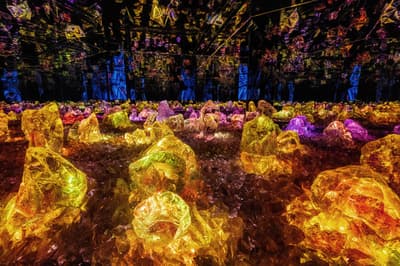
Sea of Solidified Light
teamLab, Sea of Solidified Light, 2025-, from the series Sea of the sun, 2024- © teamLab. Shot in real space. No AI or CGI.
The light inside the rocks solidifies and melts together. It changes under the influence of nearby artworks and through the behavior of people.
It interacts with Tea in Spontaneous Order, and their blinking rhythms draw closer to each other.
The work is made of glass rocks, produced by crushing the residual glass left in the melting furnaces of a glass factory.
Plate for the Sea of Light
teamLab, Plate for the Sea of Light, from the series Sea of Light on the Pedestal, 2024-, Interactive Installation © teamLab. Shot in real space. No AI or CGI.
Rippling light.
The phenomenon is the existence of the artwork. The phenomenon is born from the environment, and the environment sustains its existence.
Drinks (Selection)
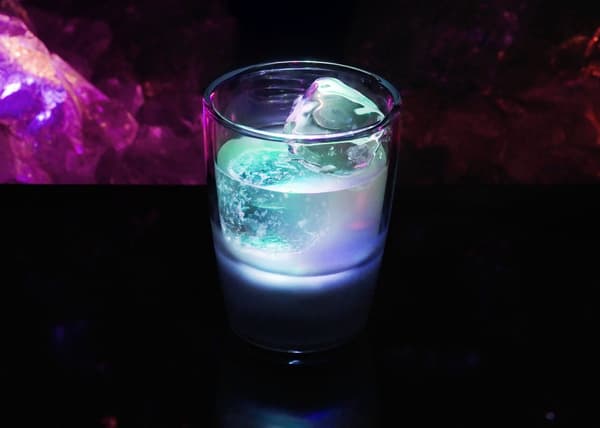
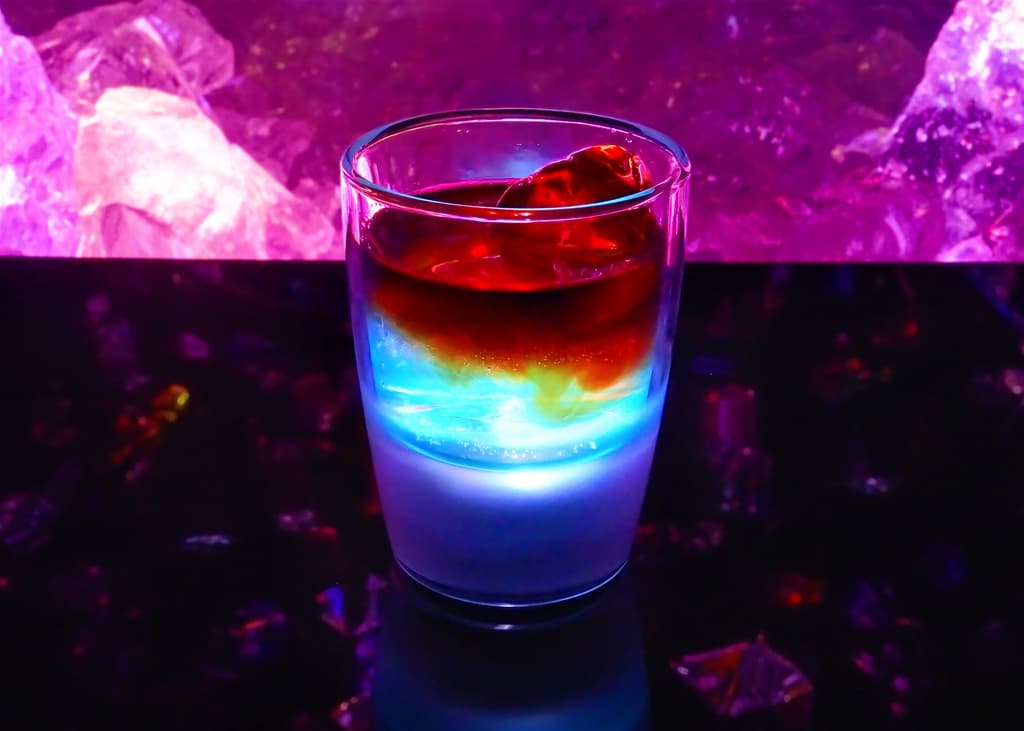
月茶 (Tsuki-cha), Tea in Spontaneous Order, 2021- © teamLab. Shot in real space. No AI or CGI. No coloring agents used.
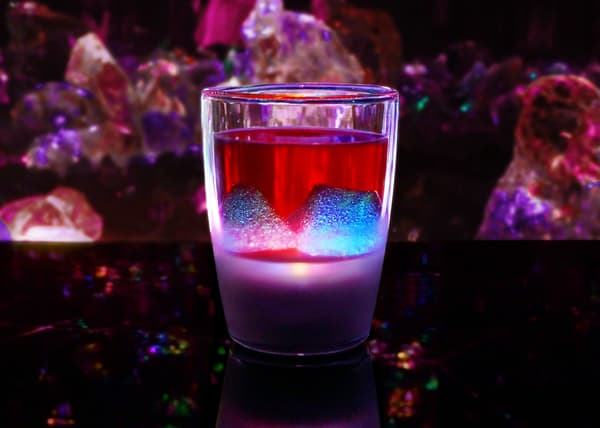
Japanese black tea with orange and rose kohakuto, Tea in Spontaneous Order, 2021- © teamLab. Shot in real space. No AI or CGI. No coloring agents used.
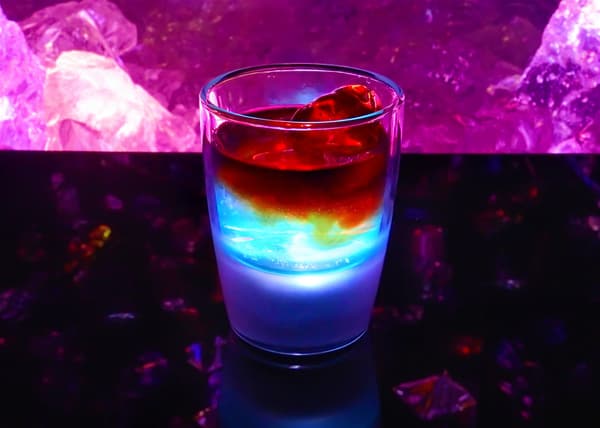
Aged coffee tonic, Tea in Spontaneous Order, 2021- © teamLab. Shot in real space. No AI or CGI. No coloring agents used.
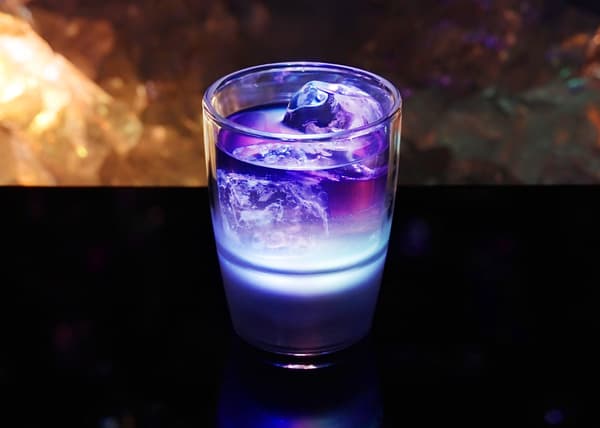
Butterfly pea tea, Tea in Spontaneous Order, 2021- © teamLab. Shot in real space. No AI or CGI. No coloring agents used.
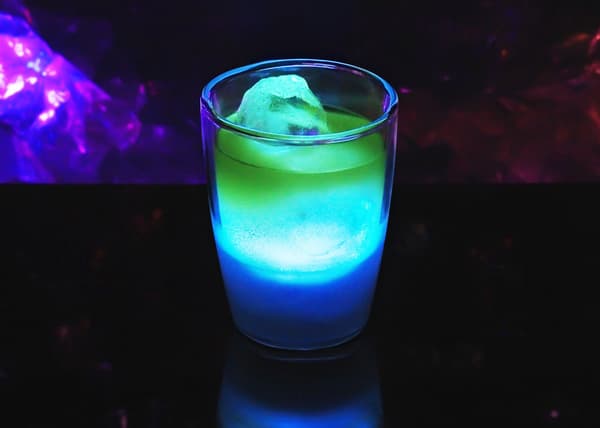
Cold-brew yuzu green tea tonic, Tea in Spontaneous Order, 2021- © teamLab. Shot in real space. No AI or CGI. No coloring agents used.
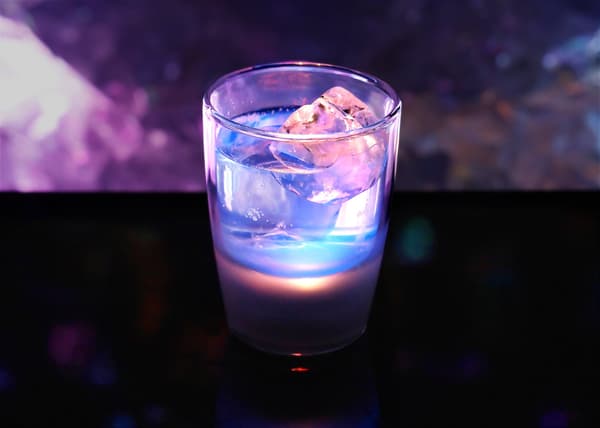
Lemongrass and cardamom, Tea in Spontaneous Order, 2021- © teamLab. Shot in real space. No AI or CGI.
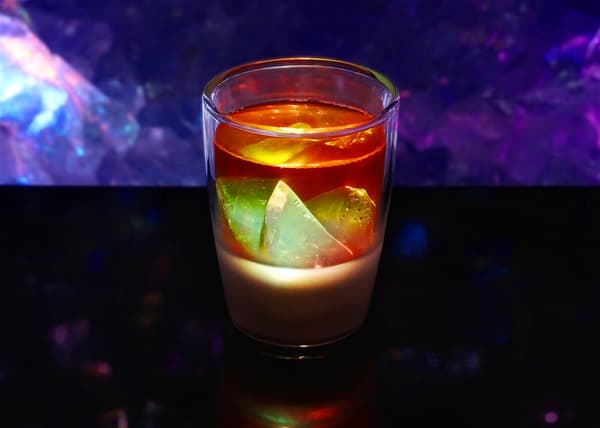
Chamomile roasted tea with lemon kohakuto, Tea in Spontaneous Order, 2021- © teamLab. Shot in real space. No AI or CGI. No coloring agents used.
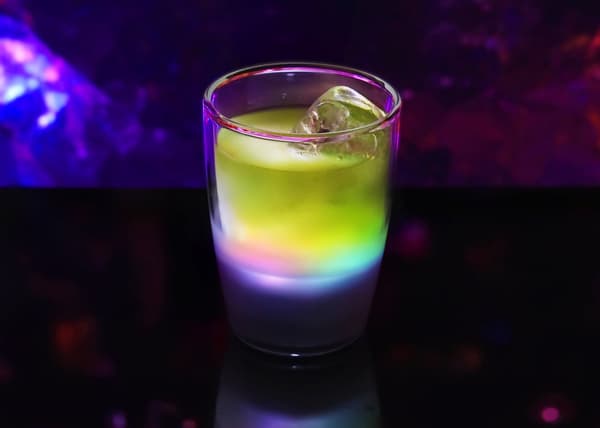
Cold-brew yuzu green tea, Tea in Spontaneous Order, 2021- © teamLab. Shot in real space. No AI or CGI. No coloring agents used.
Desserts (Selection)
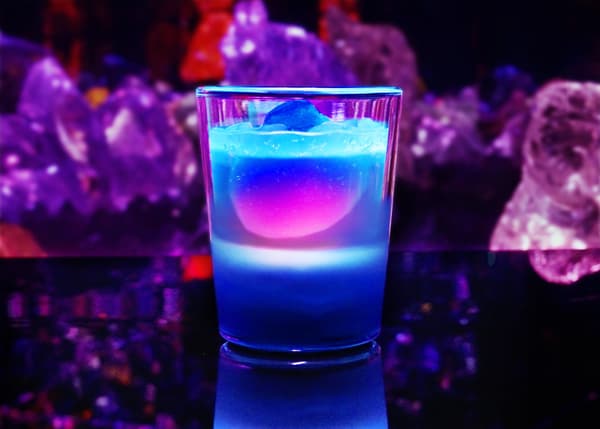
White grape and rose jelly, Tea in Spontaneous Order, 2021- © teamLab. Shot in real space. No AI or CGI. No coloring agents used.
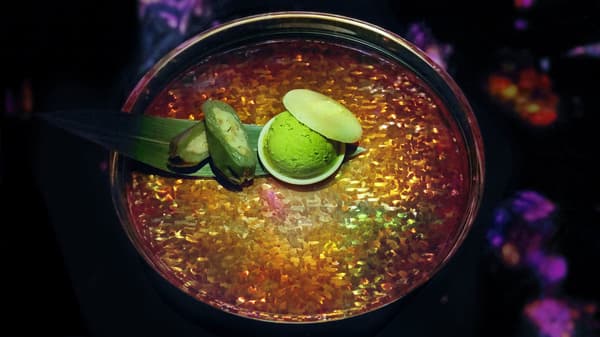
Sasa mochi with walnut miso filling and matcha coconut ice cream, Plate for the Sea of Light, from the series Sea of Light on the Pedestal, 2024-, Interactive Installation © teamLab. Shot in real space. No AI or CGI. No coloring agents used.
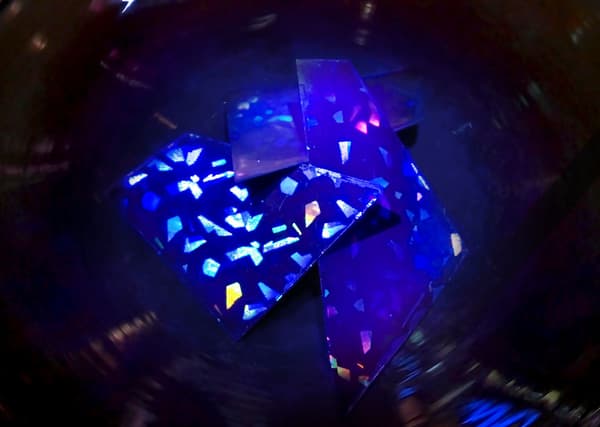
Yuzu and nut chocolate ganache, Chocolate for Radiance © teamLab. Shot in real space. No AI or CGI. No coloring agents used.
More Artworks
Bloom of Solidified Light
teamLab, Bloom of Solidified Light, 2025 © teamLab. Shot in real space. No AI or CGI.
The light inside the rocks solidifies, and flowers bloom.
When viewers move their bodies and change the angle from which they look, the way the flowers appear changes as well. What forms the flowers is not a fixed object but the relationship among the light, the rocks, and the body that looks at them.
The work is made of glass rocks, produced by crushing the residual glass left in the melting furnaces of a glass factory.
Continuous Existence
teamLab, Continuous Existence, 2024- © teamLab. Shot in real space. No AI or CGI.
Images that keep changing over time become unstable when people touch them, and that instability in turn gives rise to new images.
Pocket Garden of Eternal Existence
Alongside the opening of Teahouse in a Sea of Light, a new artwork, Pocket Garden of Eternal Existence, is also unveiled at the entrance to teamLab Biovortex Kyoto.
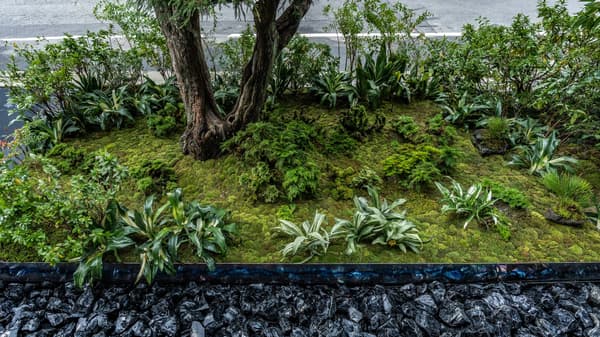
teamLab, Pocket Garden of Eternal Existence, 2026 © teamLab. Shot in real space. No AI or CGI.
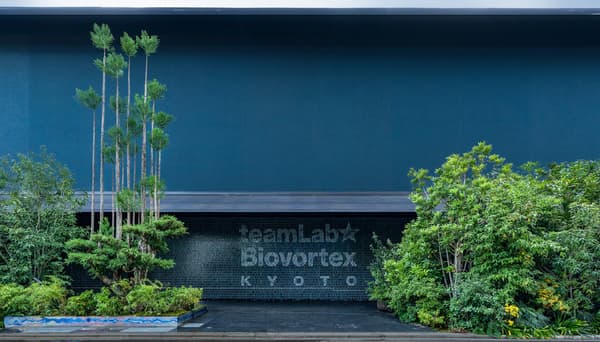
teamLab, Pocket Garden of Eternal Existence, 2026 © teamLab. Shot in real space. No AI or CGI.
The pocket garden at the entrance is dotted with a 200-year-old Kitayama daisugi cedar of Kyoto, alive since the Edo period, along with classical horticultural plants such as Omoto (オモト), Iwahiba (イワヒバ), and Matsubaran (マツバラン), which are likewise said to have been alive since the Edo period.
The Reversal of Value: Where Does Eternity Reside?
In the middle to late Edo period, before the modern era (the latter half of the 18th century to the first half of the 19th century), the paintings of Maruyama Okyo, Ito Jakuchu, and others matured in Kyoto, and at the same time classical horticulture developed in its own distinct way.
Classical horticulture is a horticultural culture that developed uniquely in the Edo period, in which extremely rare mutants appearing among wild species were discovered, selected, preserved, and passed down. At the time, these plants were resold at high prices, much like today's art auctions, and some were worth enough that a single plant could build a mansion. According to research, prices rose to 300 to 400 ryo per plant during the Tenpo era (1830–44), and a record remains of a price as high as 2,300 ryo per pot at the end of the 18th century.
By contrast, paintings by Okyo, Jakuchu, and others were not repeatedly resold as assets at the time. As an example of Okyo's primary market (production cost), a three-scroll set (三幅対) is recorded at 3 ryo. Toward the end of the Edo period, Okyo's works appear in the secondary market in the 書画価格録 (1861), valued at 「金一枚」 (about 25 ryo at the market rate of the Bakumatsu period) and described as having the highest market value. Even so, this was incomparably lower than the value of horticultural plants.
In the modern era, this sense of value reversed. Today, horticultural plants are not traded as enormous assets, whereas paintings are resold on the secondary market for vast sums. Might this difference have changed depending on what we perceive as eternal?
Vanishing Tree and Wildflowers - Oriental Photinia
At the entrance to the museum, Vanishing Tree and Wildflowers - Oriental Photinia is also on display.
The display period is scheduled from Thursday, November 12, to Thursday, November 26.

teamLab, Vanishing Tree and Wildflowers - Oriental Photinia, 2025, from the series Enso, 2017- © teamLab. Shot in real space. No AI or CGI.
About teamLab Biovortex Kyoto - Taisei Corporation
teamLab Biovortex Kyoto is Japan's largest teamLab museum, with the concept of "Universe of Existence, Universe of Perception."
Located within walking distance of Kyoto Station, the museum spans approximately 10,000 square meters and is made up of more than 50 artworks. These include works based on the concept of "Environmental Phenomena," the complex, three-dimensional creative movement space Athletics Forest with educational projects as its theme, Learning! Future Amusement Park for co-creation (collaborative creativity), and the Sketch Factory.
In its first year since opening, the museum has welcomed more than 1.3 million visitors from 167 countries and regions around the world.
Highlight Video: teamLab Biovortex Kyoto © teamLab. Shot in real space. No AI or CGI.
Visiting Information
teamLab Biovortex Kyoto - Taisei Corporation
https://www.teamlab.art/e/kyoto/
Address: 21-5 Higashi-Iwamoto-cho, Higashi-Kujo, Minami-ku, Kyoto City
https://maps.app.goo.gl/hykGEnPfHjujfabP7
Hours
9:00 AM – 9:00 PM (last admission 7:30 PM)
Closed
- Thursday, November 19
- Tuesday, December 15
- Tuesday, January 19
Subject to change. Please check the official website.