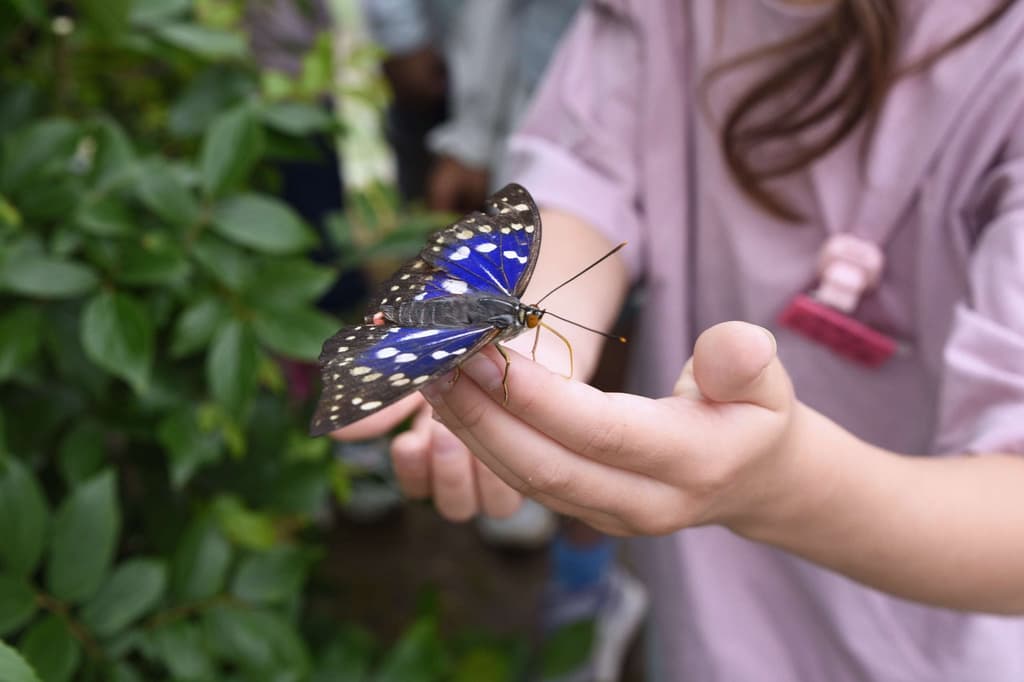
At Meipou Elementary School (Hagiwara-dai Nishi 3, Kawanishi City, Hyogo Prefecture), the Omurasaki — Japan's designated national butterfly — has hatched again this year, its wings shimmering beautifully in the school's courtyard. Raised with the support of the local civic group "Thinking About Nature and Our Town" (身近な自然とまちを考える会), the butterflies are incorporated into science classes, giving children a firsthand look at the life cycle of this stunning near-threatened species.
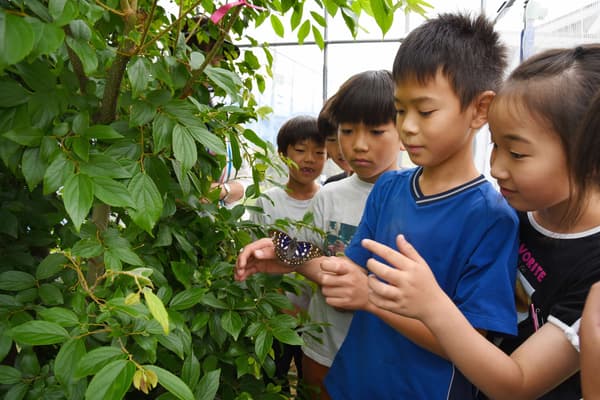
A breeding cage set up in a corner of the school courtyard houses the Omurasaki (Great Purple Emperor butterfly), designated as Japan's national butterfly by the Entomological Society of Japan and listed as a near-threatened species. The program began in 2018 as part of third-grade science classes, thanks to cooperation from the civic group. Students visit the cage during recess and free periods to watch the beautifully hatched butterflies up close.
The Omurasaki larvae feed on hackberry leaves before forming pupae, then emerge as adults between June and July. Males are distinguished by wings that are blue-purple from the base to about halfway out, accented with white spots. Females, by contrast, have reddish-brown wings without the males' vivid blue-purple coloring, and their bodies are slightly larger than those of the males.
The breeding cage inside the school measures approximately 180 cm tall by 180 cm wide and was installed with help from the civic group. Inside the cage, four hackberry trees — the larvae's preferred food source — have been planted directly in the ground. This year, two butterflies emerged on June 2. Currently, 13 pupae remain in the cage, still awaiting their turn to hatch.
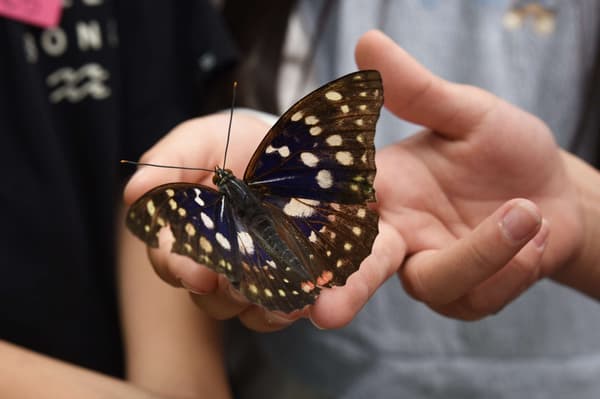
Students who encountered the butterflies shared their excitement: "The Omurasaki was so beautiful and cute. I was even able to touch one, which was really fun — and now I want to learn even more about them."