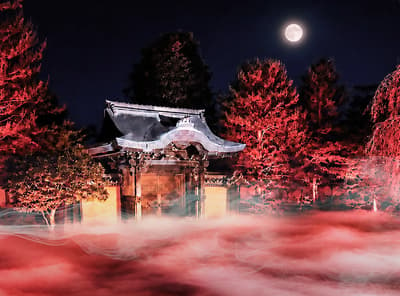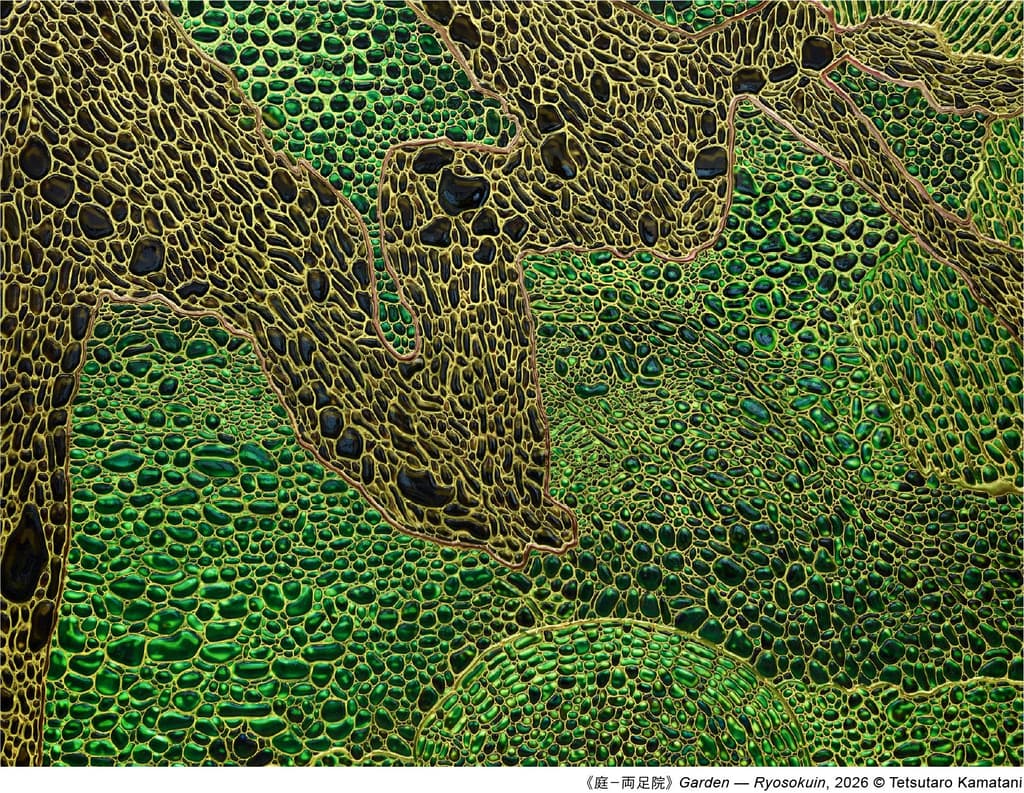
A solo exhibition by contemporary artist Tetsutaro Kamatani (鎌谷徹太郎), "Threshold between Reality and Illusion" (虚実の閾), will be held at Ryosoku-in (両足院), a Zen temple in Kyoto, from Sunday, December 6 to Wednesday, December 23, 2026.
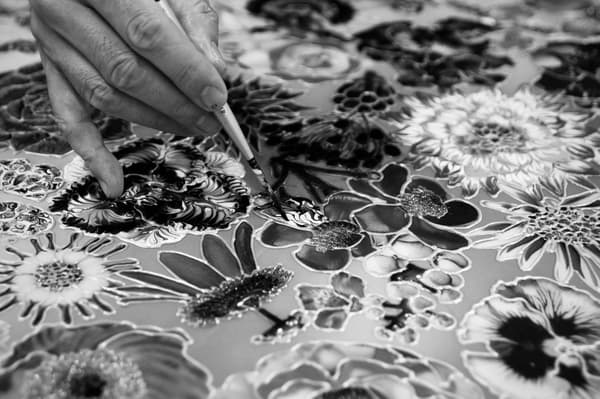
Kamatani is a contemporary artist based in Tokyo and New York. For more than 20 years, he has explored the possibilities of "collage" in painting, moving between different materials and techniques with painting at the core and expanding his expression into three-dimensional works and space. His work is shaped by organic forms that evoke nature and life, ornamental details, and many layers of different images built up at an overwhelming density that covers the entire support. At the same time, this density can draw the viewer's gaze beyond the work and toward the "blank space" (余白) that spreads outside it. Another feature is that the works show different expressions depending on the distance and viewpoint from which they are seen, which creates depth.
In this exhibition, Kamatani's expression extends into the setting of Ryosoku-in and develops into a show in which visitors experience the relationship between the works and the place itself.
Artwork, Garden, and Sound Resonate at Ryosoku-in
Ryosoku-in is a Zen temple adjacent to Gion (祇園), a hanamachi (花街) district of Kyoto, with a history of more than 600 years. It was founded in 1358 by the disciples of the Zen master Ryuzan Tokken (龍山徳見) at the time of his passing. From the Muromachi period to the Edo period, leading figures of the art world such as Hasegawa Tohaku (長谷川等伯) and Ito Jakuchu (伊藤若冲), as well as literary talents such as Ueda Akinari (上田秋成), came and went from the temple. Exchanges nurtured through calligraphy and paintings, Zen-related texts, and ceramics made it a place of cultural exchange spanning art, crafts, and literature. In recent years, it has also hosted exhibitions by contemporary artists from Japan and abroad, including installations that use hanging scrolls, sliding-door paintings (襖絵), and landscapes including the garden, in which the works respond to the space and scenery of Ryosoku-in. Building on that history and tradition, the temple actively accepts contemporary artistic expression while exploring new ways of Zen.
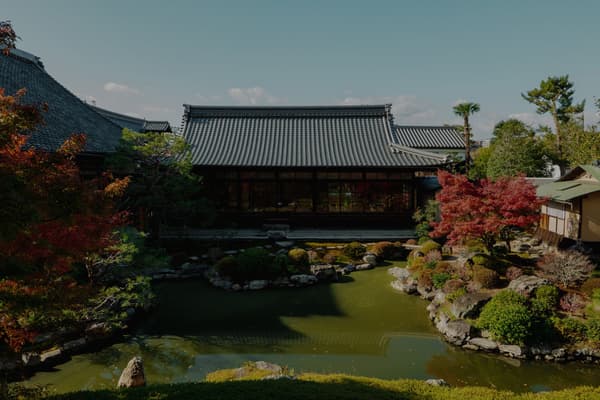
The exhibition will center on the Hojo (方丈) and the Daishoin (大書院), which are not normally open to the public, and will create a display that responds to Ryosoku-in as a whole. In the Daishoin, a large folding screen approximately 2.1 m high and 8.3 m wide, inspired by the garden visible from the hall, will be shown. The actual view of the garden and the painted world overlap, making this a display unique to Ryosoku-in.
On Saturday, December 19, a one-day-only special performance, "Meitei × Tetsutaro Kamatani × Ryosoku-in," will be held with Meitei (冥丁). Meitei continues his own musical expression around "Lost Japan" (失日本), a name he gives to scenes of Japan that remain as self-evident yet faint presences even after being lost. Kamatani's works in the space of Ryosoku-in will respond to a new piece that Meitei wrote for this exhibition, creating a scene that can appear only in this place at this time.
Visitors can experience the world of Kamatani's works resonating with Ryosoku-in at the venue.
Artist Statement: "Threshold between Reality and Illusion"
There is a garden. Facing that garden, a large folding screen has been placed.
The garden has stones, trees, and water. On the surface of the screen are countless transparent, glossy dots.
The two do not closely resemble each other. Rather, they create a world in entirely different ways.
Stones, trees and grasses, and water all have weight, occupy a certain place, and change with the seasons.
In Kamatani's painting, that garden is broken down into color and fields of color and fixed as an extremely tactile "pointillism."
The painting reflects light and first leaps into our eyes. In this way, the garden begins to exist within the eye.
It may be usual to think of the actual garden as "reality" (実) and the painted picture as "illusion" (虚).
However, a garden is by no means raw nature; it is composed nature.
On the other hand, the garden that Kamatani paints exists as a definite material. It is not a "virtual image" but exists as a thing that acts on the eye.
In other words, both are experiences that cross between reality and illusion.
The spatial arrangement of natural objects, and the retinal arrangement of "color as a thing."
The garden is not a "background," and the painting is not a "representation."
Within the garden, the work melts out, and the breath of light from the work spreads into the garden.
Between people and art, between sight and touch, between landscape and nature, between illusion and reality, this exhibition exists as if swaying.
About the Artist
Tetsutaro Kamatani (鎌谷徹太郎)
Born in Osaka in 1979. A contemporary artist based in Tokyo and New York.
Based on a sharp insight into the relationship between advanced capitalism and images, he first drew attention in the Japanese art scene with works that developed appropriation and simulation into painting. He then explored the possibilities of "collage" in painting for more than 20 years. His current body of work, made with materials he developed himself and composed of golden lines and the placement of vivid pigments, can be called one point of arrival of that exploration.
His magnificent painted world, in which images and materials intersect at high density, has also been highly praised by art professionals and collectors, and its reputation is spreading on a global scale.
Recent Major Exhibitions and Activities
- 2026: Solo exhibition commemorating the publication of his art book, "表層の彼方" (LIVE ART GALLERY, Tokyo)
- 2025: "GOLDEN CLOUDS" (Pellas Gallery, Boston)
- 2024: "Resonance of Tradition and Innovation" (Pellas Gallery, Boston)
- 2024: TATSUNO ART PROJECT #00 curated exhibition "Regenergize" (生命が響き合う共生の輪) (Osaka)
- 2023: Gold Medal at the Chelsea Flower Show, organized by the Royal Horticultural Society, in collaboration with architect Kengo Kuma (隈研吾) and garden designer Kazuyuki Ishihara (石原和幸)
- 2023: "超複製技術時代の芸術 NFTはアートの何を変えるのか?" (GYRE GALLERY, Tokyo)
- 2023: "art stage OSAKA 2023 - すべてが計算された世界でまだ祈るべきものは残されているのか" (Grand Cube Osaka (グランキューブ大阪), Osaka)
Main Collections
His works are held in private and corporate collections in Japan and abroad, including those of Archduke Géza von Habsburg (ゲーザ・フォン・ハプスブルク大公), Gloria Starr Kins (グロリア・スター・キンズ), Rachel Lehmann (レイチェル・リーマン), and David Craig Teplitzky (デヴィッド・クレイグ・テプリツキ).
Representative Works
Layering vivid colors and diverse motifs, Kamatani builds densely packed pictures. They depict a unique worldview in which reality and imagination, memory and culture intersect.
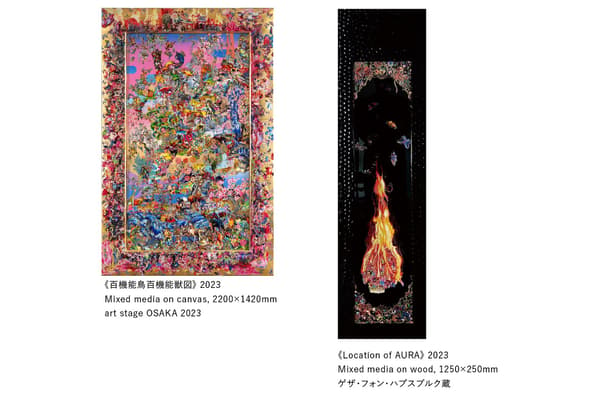
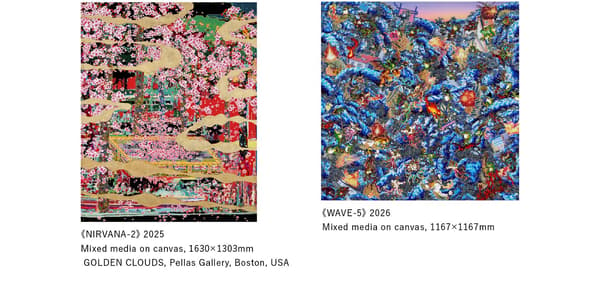
One-Day Special Performance "Meitei × Tetsutaro Kamatani × Ryosoku-in"
On Saturday, December 19, as a collaboration titled "Meitei × Tetsutaro Kamatani × Ryosoku-in," the musician Meitei will premiere a new piece written for this exhibition. In this one-day-only special performance, Kamatani's works, the space of Ryosoku-in, and Meitei's sound resonate with one another. For application details, please see the official website.
Meitei (冥丁)
Creating a musical "form" from "Lost Japan" (失日本)
A musician from Onomichi, Hiroshima, based in Kyoto.
He names the delicate impression of Japan that everyone feels but cannot capture in words, a "Japan that drifts as something self-evident yet faint," "Lost Japan" (失日本). Using modern music technology, he edits traditional impressions of Japan and continues to present a "form" for making music that starts from his own culture and sensibility. His trilogy of "Kwaidan" (怪談), "Komachi" (小町), and "Kofu" (古風) has been highly acclaimed in Japan and abroad and has been covered by leading overseas music media such as The Wire and Pitchfork. In recent years, he has expanded his activities to temples, cultural properties, art museums, and museums.
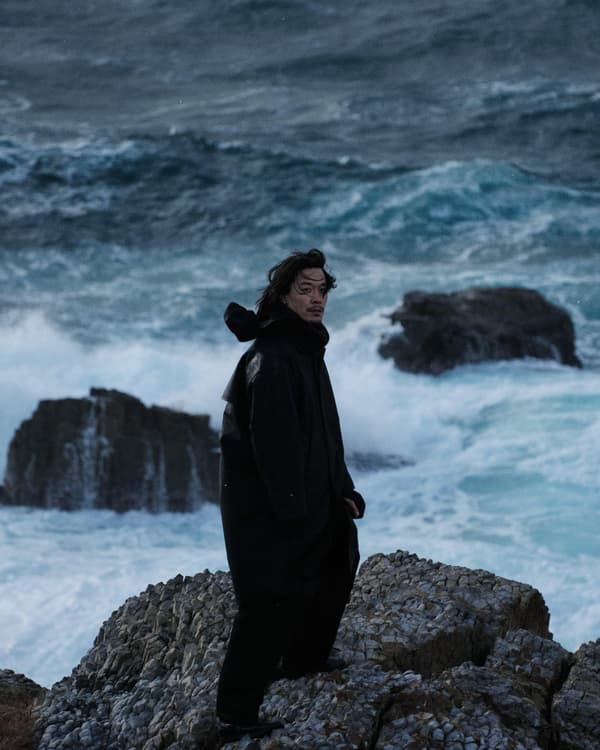
Photo: 岡本裕志
Recent Activities
- 2026: Dedicatory performance on the main hall stage of Kiyomizu-dera (清水寺) on Mt. Otowa, a World Heritage site
- 2026: Released the album "瑪瑙" and toured 三夜沢赤城神社 and Wakayama Castle (和歌山城)
- 2026: Took part in the Yebisu International Festival for Art & Alternative Visions (恵比寿映像祭) at the Tokyo Photographic Art Museum (東京都写真美術館)
Exhibition Details
Tetsutaro Kamatani "Threshold between Reality and Illusion" (虚実の閾)
Dates: Sunday, December 6 – Wednesday, December 23, 2026
Hours: 1:00 PM – 5:00 PM (last entry 4:30 PM)
Venue: Ryosoku-in (両足院)
Address: 591 Komatsu-cho, Yamatooji-dori Shijo-sagaru 4-chome, Higashiyama-ku, Kyoto (京都府京都市東山区大和大路通四条下る4丁目小松町591)
Admission: General ¥1,000 / Junior high and high school students ¥500 / Elementary school students and younger free
Official website: https://tetsutarokamatani-exhibition.com
Organizer: imi Inc.
Co-organizers: GALLERY.S / enigma Inc. (株式会社enigma)
Special cooperation: Ryosoku-in
Please note the following.
- The temple is closed to general visitors on Saturday, December 19, due to the special performance "Meitei × Tetsutaro Kamatani × Ryosoku-in."
- Junior high and high school students need to show a student ID.
- Admission is free for visitors who show a disability certificate or similar, and for one companion.