Yokohama Noh Theater (横浜能楽堂) will hold a "Yokohama Kyogendo" (横浜狂言堂) performance on Sunday, December 13. The Zenchiku family (善竹家), who are mainly active in the Kansai region, will appear for the first time in 15 years.
The series carries the slogan "We've decided on our own: the second Sunday of every month is Kyogen Day," and is designed to let audiences enjoy kyogen casually. The December program consists of two plays: "Futari Daimyo" (二人大名), in which the comical behavior of two daimyo (feudal lords) draws laughs, and "Susugigawa" (濯ぎ川), which portrays a man at the mercy of his wife and mother-in-law.
What Is Kyogen?
Kyogen is one of Japan's leading classical performing arts. Like Noh, it was established in the Muromachi period (室町時代).
While Noh tells stories about gods, warriors, and other figures mainly through dance and chanting, kyogen features people of medieval times and expresses the joys, angers, sorrows, and pleasures of everyday life that anyone can relate to, through humorous dialogue and expressive physical movement.
Some people may think classical performing arts are difficult, but kyogen is full of appeal that modern audiences can relate to, such as the exchanges between characters and scenes that make you laugh. Because the story moves forward mainly through dialogue, it is approachable even for first-time viewers and is also recommended as an entry point to classical performing arts.
The Zenchiku Family Returns with "Susugigawa," Based on a French Farce
The December Yokohama Kyogendo features the Zenchiku family, who are mainly active in the Kansai region. The family carries on the art of Zenchiku Yagoro (善竹彌五郎), the first Living National Treasure in the kyogen world, and is known for a style that values traditional form. This will be their first appearance at Yokohama Kyogendo in 15 years.
"Susugigawa" is a new kyogen inspired by the medieval French farce "The Washtub" (洗濯桶). Playwright Iizawa Tadasu (飯沢匡) wrote the script for modern theater, and in Showa 28 (1953) it premiered under the direction of Takechi Tetsuji (武智鉄二) as a work more in the style of kyogen.
The protagonist is a timid man who has been worked hard by his wife and mother-in-law since his marriage. One day, having finally reached his limit, he has the two of them write down every errand they have given him and secures their promise that he will not do anything that is not written on the paper.
The man, who has always worked as he was told, uses his wits to try to take back control of the household. Will his plan succeed?
The comedy of a man struggling against a domineering wife and mother-in-law, along with its unexpected turns, makes "Susugigawa" a play that audiences can relate to across the ages. It is a highly popular work among the new kyogen created after the war.
Both first-time viewers and longtime kyogen fans are welcome at the performance on the second Sunday of December.
Performance Details
Outreach performance "Yokohama Kyogendo"
Date and time: Sunday, December 13, 2:00 PM start
Venue: Yokohama Noh Theater (横浜能楽堂)
Admission: ¥2,500 (tax included, all seats reserved)
Booking:
- Tel: 045-263-3055 (9:00 AM – 6:00 PM)
- Web: https://yokohama-nohgakudou.org/
Program:
- Talk: Zenchiku Takashi (善竹隆司)
- Kyogen "Futari Daimyo" (Okura school): Okura Yataro (大藏彌太郎)
- Kyogen "Susugigawa" (Okura school): Zenchiku Ryuhei (善竹隆平)
For group reservations of 10 or more tickets, please inquire.
Organizer: Yokohama Noh Theater (横浜能楽堂, 公益財団法人横浜市芸術文化振興財団)
Synopses of the Two Plays
Kyogen "Futari Daimyo"
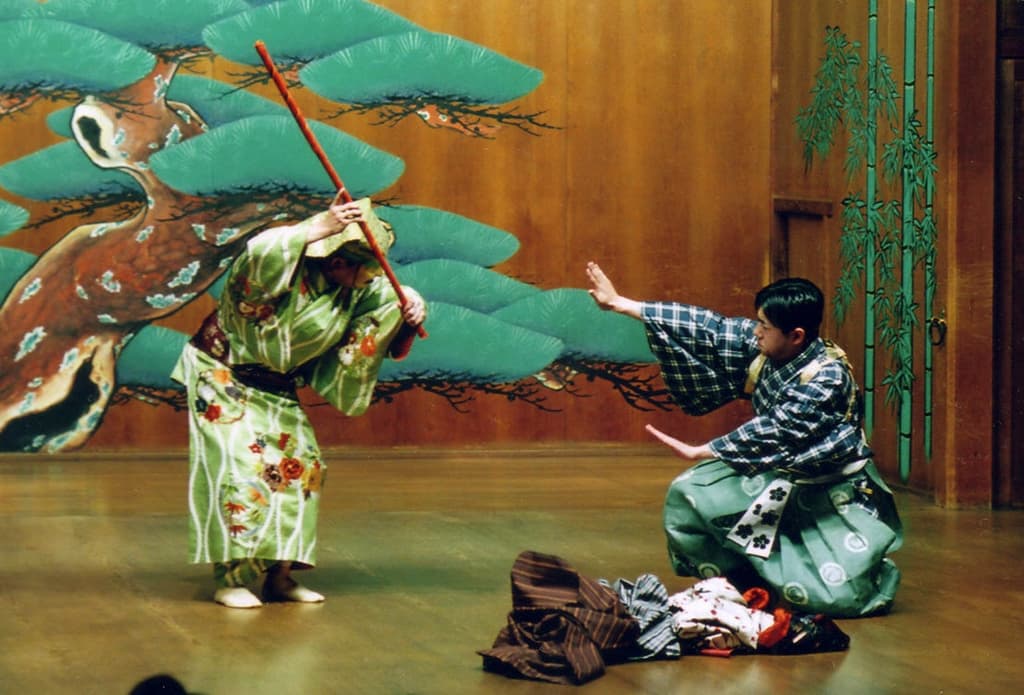
A daimyo invites another daimyo to travel to the capital. As they have no attendant to carry their long sword, they force a passing man to carry it. The man, angered by the daimyo's arrogant attitude, raises the sword and threatens them. The daimyo are stripped of their short sword, kosode robes, and kamishimo (formal attire), and are even made to imitate fighting dogs, fighting cocks, and a roly-poly doll (okiagari-koboshi). At first they do as they are told, but before long they get carried away, and in the meantime the man runs off with the long sword, short sword, and costumes.
The highlights are the daimyo's comical imitations and their rhythmic movements set to a short song.
Kyogen "Susugigawa"
A timid man is constantly overworked by his wife and mother-in-law. While he is washing laundry at the river today, the mother-in-law and the wife appear in turn and keep ordering him to do one thing after another. There are so many errands that the man tells the two to write them down on paper so he will not forget them. He then secures a promise that he does not have to do anything that is not written on the paper, but...