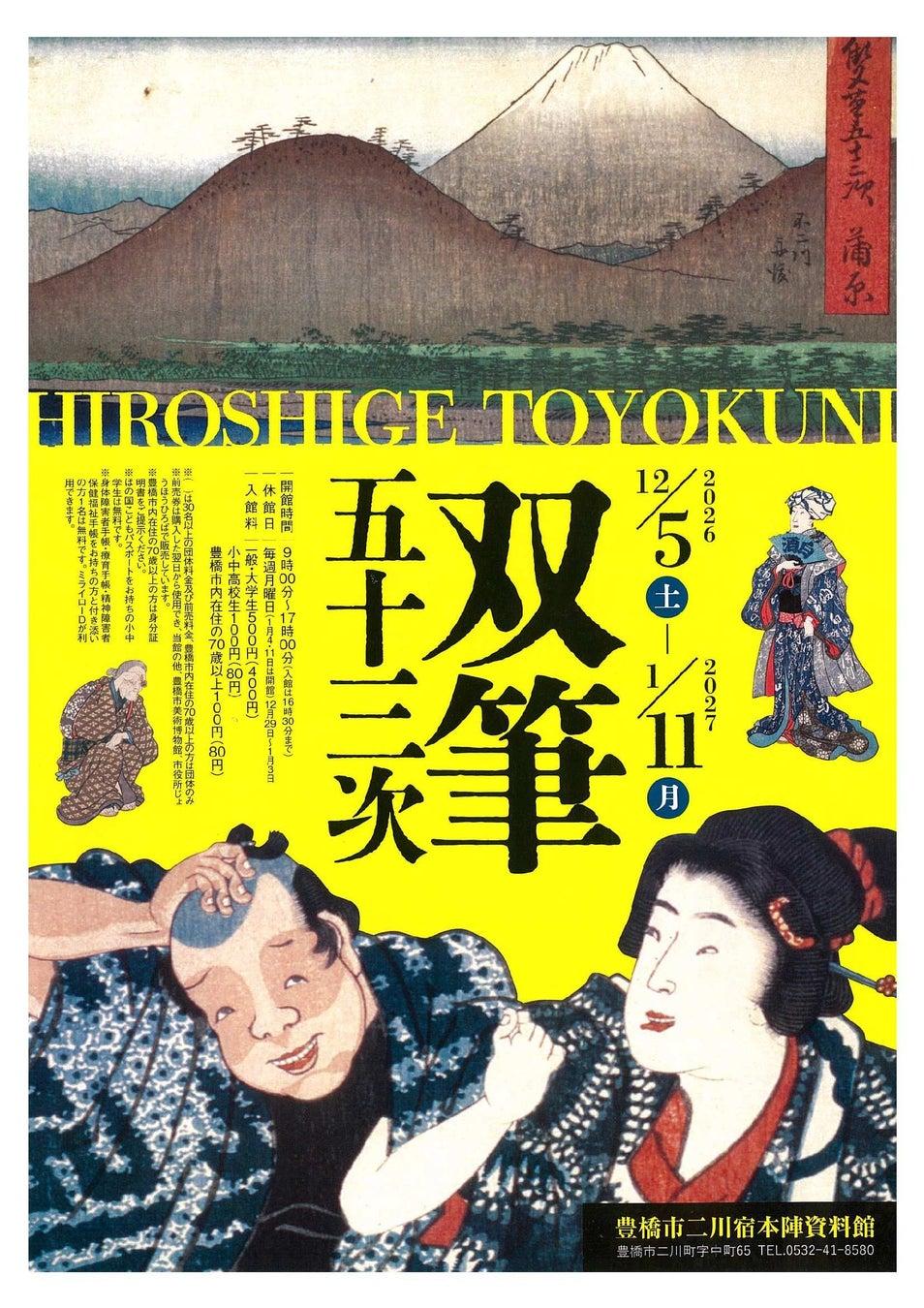
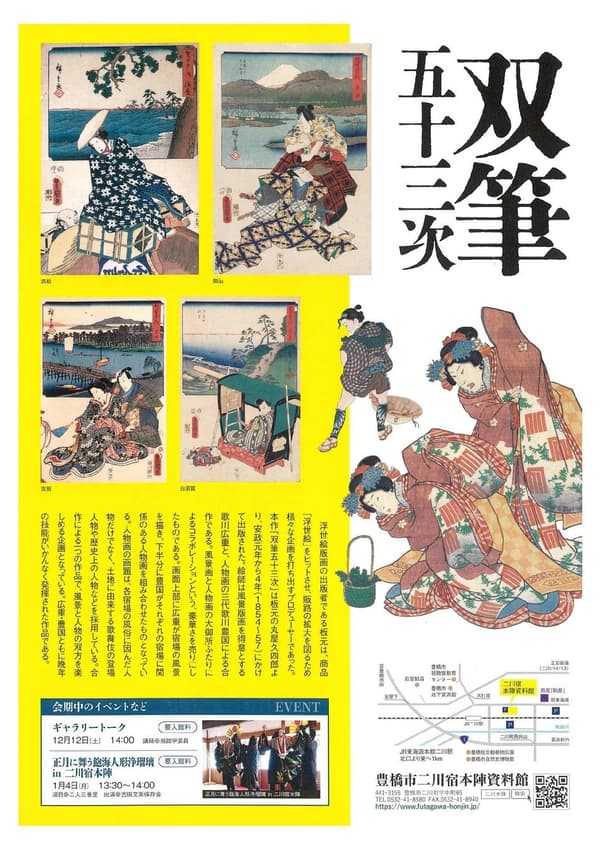
A special exhibition of "Fifty-three Stations by Two Brushes" (双筆五十三次) will be held at the Toyohashi City Futagawa-juku Honjin Museum in Toyohashi, Aichi Prefecture. The series is a joint work by Utagawa Hiroshige, who excelled at landscapes, and Utagawa Toyokuni III, a master of figure painting. Set at the post towns of the Tokaido's fifty-three stations, each print has Hiroshige's view of the post town in the upper part of the picture and, in the lower half, Toyokuni's figure painting connected to that post town.
The exhibition gathers these collaborative works by two masters, which evoke the atmosphere of travel in the Edo period and offer glimpses of the lively daily life of the people.
About Futagawa-juku and the Honjin Museum
Futagawa-juku is the 33rd of the Tokaido's fifty-three stations, counting from Nihonbashi. It is the first post town after entering Mikawa Province (present-day eastern Aichi Prefecture) from Suruga Province (present-day western Shizuoka Prefecture).
Futagawa-juku retains its Edo-period town layout almost as it was. The Futagawa-juku Honjin Museum there preserves the "honjin" (本陣), an important building within the post town that high-ranking travelers such as daimyo and court nobles used for lodging and rest during their journeys, and exhibits materials related to travel in the Edo period.
Special Exhibition "Fifty-three Stations by Two Brushes" – Details
- Period: December 5, 2026 (Sat) to January 11, 2027 (Mon, holiday)
- Venue: Toyohashi City Futagawa-juku Honjin Museum, Special Exhibition Room
- Hours: 9:00 AM to 5:00 PM (last entry 4:30 PM)
- Admission:
- General: ¥500 (¥400)
- Elementary, middle, and high school students: ¥100 (¥80)
- Toyohashi residents aged 70 and over: ¥100 (¥80)
- Prices in parentheses are advance-sale prices. Admission also covers the special exhibition.
- Closed: Every Monday, and December 29 (Tue) to January 3 (Sun). The museum is open on January 4 (Mon) and January 11 (Mon, holiday).
A Collaborative Series Showing Each Artist's Individuality and Talent
In the Edo period, the "hanmoto" (板元), the publishers of ukiyo-e woodblock prints, acted somewhat like producers. To make their product, ukiyo-e, a hit and expand its sales channels, they came up with a variety of projects.
"Fifty-three Stations by Two Brushes" is a series that tours the fifty-three post towns of the Tokaido. It was published by the hanmoto Maruya Kyushiro (丸屋久四郎) between the first and fourth years of the Ansei era (1854–57).
The series is a collaboration between Utagawa Hiroshige, who excelled at landscape prints, and Utagawa Toyokuni III, a master of figure painting. It was marketed on the appeal of bringing together leading masters of each field: Hiroshige painted the scenery of each post town in the upper part of the picture, and Toyokuni painted figures connected to that post town in the lower half.
Both Hiroshige and Toyokuni made full use of their late-career skills. The works are valued for their high artistic quality, and they are also valuable for what they reveal about the travel customs and daily life of Edo at the time.
A Brief Look at the Works
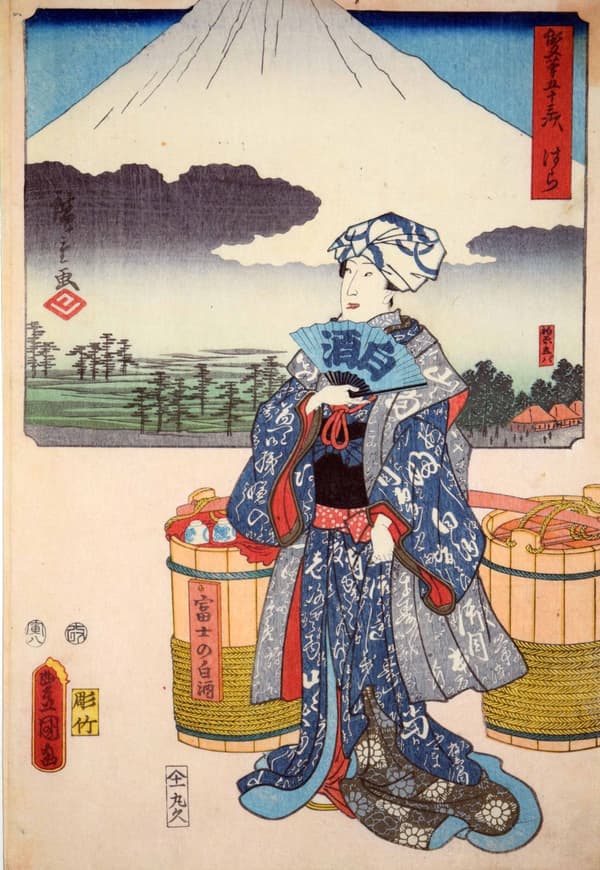
Fifty-three Stations by Two Brushes – Hara (held by the museum)
This print depicts Hara-juku (原宿), the 13th of the Tokaido's fifty-three stations, in present-day Numazu, Shizuoka Prefecture. Hiroshige's landscape has a dynamic composition in which Mount Fuji extends beyond the frame of the picture. The figure painting shows a woman selling "Fuji White Sake" (富士の白酒), a specialty of the area.
The subjects of the figure paintings are not limited to people tied to the customs of each post town. Kabuki characters and historical figures connected to the locale were also used.
Gallery Talk
Visitors can hear the highlights of the special exhibition directly from a curator.
- Date and time: December 12, 2026 (Sat), from 2:00 PM
- Venue: Futagawa-juku Honjin Museum
- Fee: Free (admission required)
- Registration: Not required
Events During the Exhibition – A Taste of an Edo-Period New Year at Futagawa-juku Honjin Museum
Edo-Style Kadomatsu on Display
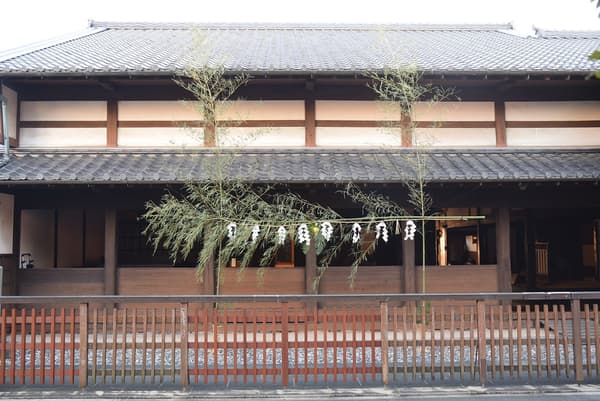
The museum has reconstructed the kadomatsu (New Year pine decoration) shown in an illustration in "Mikawa no Kuni Yoshida Meisho Soroku" (三河国吉田名蹤綜録), a gazetteer written in the Edo period (around 1806). The book introduces the area around the Yoshida castle town, including its temples and shrines, festivals, famous places, historic sites, and the origins of place names. The kadomatsu is scheduled to be set up from mid-December.
New Year Performance of Akumi Puppet Theater at Futagawa-juku Honjin
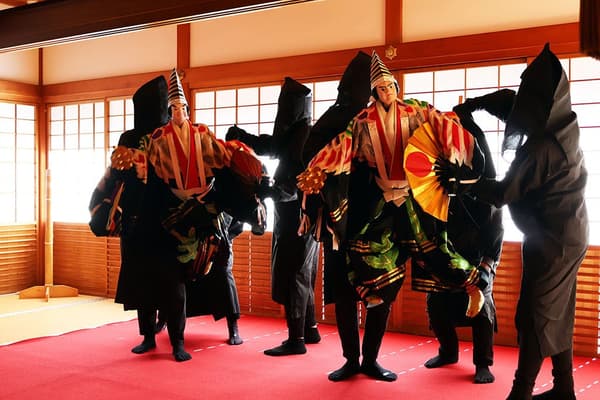
Sanbaso (三番叟), a dance praying for bountiful harvests and the prosperity of descendants, will be performed.
- Date and time: January 4 (Mon), 1:30 PM to 2:00 PM
- Program: Ninin Sanbaso (二人三番叟)
- Performers: Yoshida Bunraku Preservation Society (吉田文楽保存会)
- Fee: Free (admission required)
More New Year Events
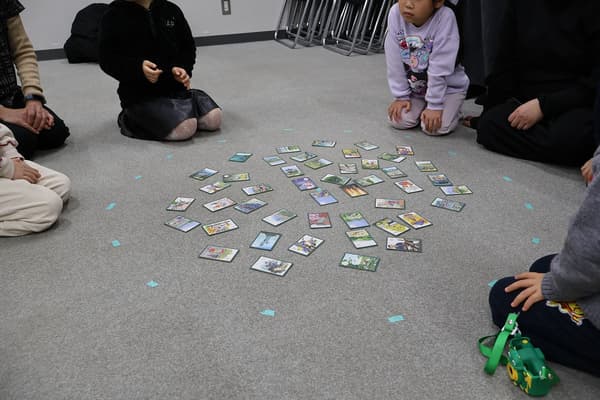
Other events that bring the New Year atmosphere include displays of New Year decorations and New Year-themed hanging ornaments (tsurushi-kazari), and the "Iitoko Hakken! Toyohashi Karuta Tournament" (いいとこ発見!とよはしカルタ大会).
The museum offers a way to enjoy the atmosphere of Edo at the start of 2027.
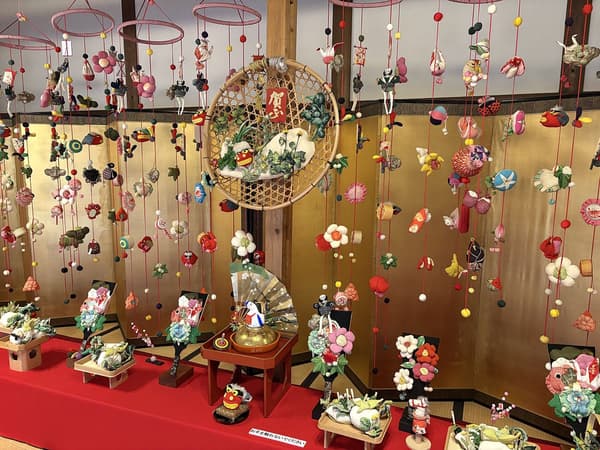
New Year tsurushi-kazari (hanging ornaments)
Karuta tournament