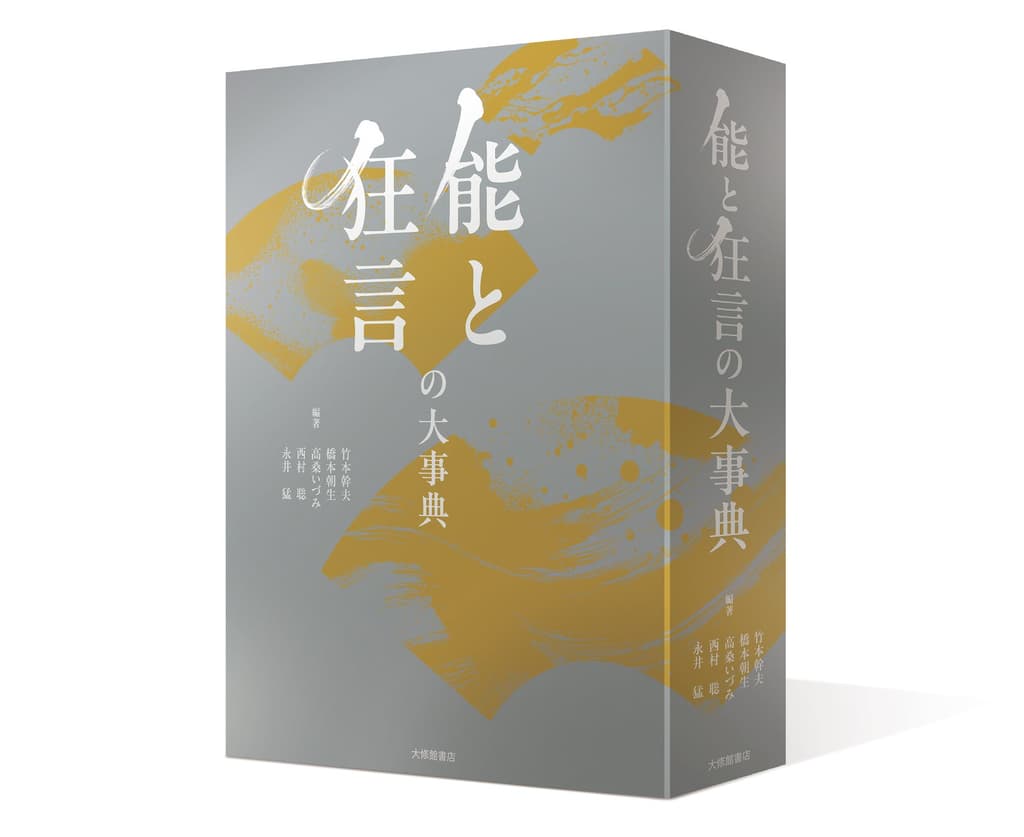
Taishukan Shoten published a new dictionary of Noh and Kyogen, 能と狂言の大事典 (edited by Takemoto Mikio and others), on July 1, 2026.
Noh and Kyogen are traditional Japanese performing arts that have been passed down for more than 600 years, making them among the oldest surviving theatrical traditions in the world. As interest in Noh and Kyogen continues to grow both in Japan and abroad, this new volume brings together the latest research on the art forms alongside explanations written to be accessible to beginners.
The dictionary was written and edited over 18 years by 65 specialists.
Renewed Interest in Noh and Kyogen at Home and Abroad in 2026
- 風姿花伝, a 15th-century treatise on theater by Zeami, is a candidate for UNESCO's Memory of the World register.
- At the Sibiu International Theatre Festival, one of Europe's three major international theater festivals, Yamamoto Noh Theatre (Osaka) received the Walk of Fame award, the festival's equivalent of a hall-of-fame induction.
- Toyotomi Hideyoshi's ties to Noh are drawing attention amid the popularity of the Taiga drama 豊臣兄弟 (Nagoya Noh Theater).
- The fan base is expanding through connections with manga and anime, including the start of stage performances tied to 刀剣乱舞 and 日出処の天子, and the start of broadcasts for ワールド イズ ダンシング.
- As inbound tourism grows, international outreach is increasing as well, including overseas performances and productions with English subtitles.
Features of the Dictionary
- Contains about 4,800 entries, more than any comparable dictionary.
- Covers current repertoire pieces, rarely performed works, and lost plays, with comprehensive explanations of plot, staging, and source material. For Kyogen, nearly all surviving major scripts are introduced.
- Includes extensive entries and descriptions related to staging and performance techniques.
- Introduces roughly 14,000 research references in total, offering an extensive body of reference material.
- Also includes a list of chant notation symbols, a list of major Noh stages and theaters, and a chronology of Noh history.
- Historical analysis is emphasized throughout, making the dictionary a useful reference for research in other fields as well.
Publication Details
能と狂言の大事典
Edited by Takemoto Mikio, Hashimoto Asao, Takakuwa Izumi, Nishimura Satoshi, and Nagai Takeshi
B5 size, hardcover with slipcase, 1,040 pages
Price: ¥35,200 (¥32,000 plus tax)
Released July 1, 2026
ISBN: 978-4-469-01293-4
Editors
Takemoto Mikio (Professor Emeritus, Waseda University)
Hashimoto Asao (former Professor, University of Yamanashi)
Takakuwa Izumi (Researcher Emeritus, Tokyo National Research Institute for Cultural Properties)
Nishimura Satoshi (Professor Emeritus, Kinjo University)
Nagai Takeshi (Professor Emeritus, National Institute of Technology, Yonago College)
Profile: Takemoto Mikio
Born in Tokyo in 1948. Completed the coursework requirements for the doctoral program at Waseda University's Graduate School of Letters, Arts and Sciences in 1979, and holds a Ph.D. in Literature. He served as a full-time lecturer and later associate professor at Jissen Women's University from 1980, then as associate professor and later professor in the Faculty of Letters, Arts and Sciences at Waseda University from 1987 until March 2019, after which he became Professor Emeritus at Waseda University. In 2004 he became director of the university's Tsubouchi Memorial Theatre Museum, a post he held until 2012. His specialty is medieval literature, particularly Noh. His major works include 日本の文学 古典編『能・能楽論・狂言』(co-edited with Hashimoto Asao, Horupu Shuppan, 1987), 岩波講座 能狂言Ⅱ『能楽の伝書と芸論』(co-authored with Omote Akira, Iwanami Shoten, 1988), 『早稲田大学演劇博物館蔵特別資料目録5 貴重書 能・狂言篇』(supervising editor, Waseda University Tsubouchi Memorial Theatre Museum, 1997), 『観阿弥・世阿弥時代の能楽』(Meiji Shoin, 1999), and 『風姿花伝・三道――現代語訳付き』(annotated translation, Kadokawa Sophia Bunko, 2009), among others.
From the Editors
In the modern era, novelty and accessibility have become the standards by which the value of something is judged. Both are important, but there is a concern that classical works tend to be undervalued as a result. Noh and Kyogen, together known as Nogaku, are among such classical arts. Performing them was once the foremost pastime among Japanese people, but today even audiences, let alone performers, have grown scarce. There is no doubt that Noh and Kyogen are performing arts of world renown, yet when one looks at how they are actually sustained in present-day Japan, the foundation supporting them is fragile. This phenomenon, likely common to classical arts and the humanities in general, is also reflected in how knowledge about Noh and Kyogen is structured: while research has advanced considerably, knowledge available to the general public has not kept pace with that progress. This dictionary was compiled in an effort to bridge that gap by bringing together comprehensive, up-to-date knowledge related to Nogaku.
While the content is highly specialized in places, effort was made to keep it as accessible as possible. As a result, many entries are less concise summaries than exhaustive accounts, with some running longer than is typical for a dictionary. Most entries are structured around historical development, exploring why things are the way they are today, giving the work a scope and depth without direct precedent. That is the reason it was named 能と狂言の大事典.
The editors hope this dictionary will help readers gain a better and deeper understanding of the classical world of Nogaku.
(Excerpted and adapted from the book's foreword.)
Pamphlet
A PDF pamphlet can be downloaded here.