The Liszt Hungarian Cultural Center (リスト・ハンガリー文化センター), the cultural department of the Hungarian Embassy in Azabu-Juban, Tokyo, will hold "In Flow – Nagare" (NAGARE 流れ), the first solo exhibition in Japan by contemporary artist Laura Medcalf (メドカルフ・ラウラ). The exhibition runs from Wednesday, November 18, 2026 to Wednesday, March 31, 2027. Medcalf has roots in both Hungary and the United Kingdom.
Washi paper made in Mino City, Gifu Prefecture, is carried to Hungary and turned into artwork on the banks of the Danube. On Naoshima and the Seto Inland Sea in Japan, Medcalf works with the light and water of the shore. Her works carry the nature she encounters in each place, along with the handwork of people. Soaking them in river or sea water brings out a range of blues, and visitors can follow the works one by one, traveling from Hungarian rivers to the Japanese sea.
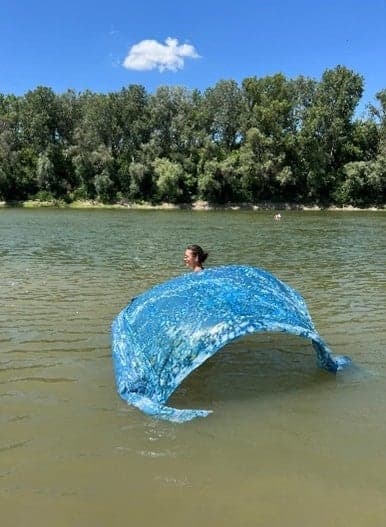
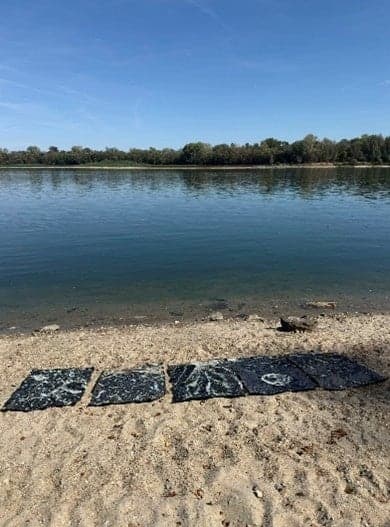
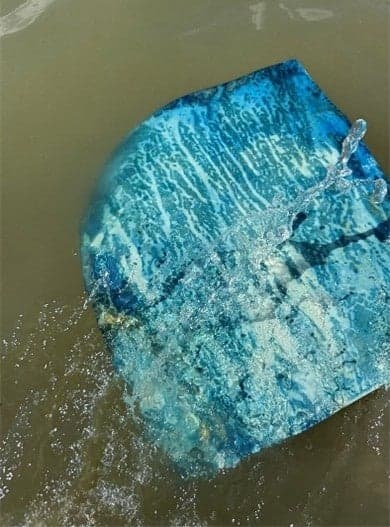
Photographs documenting the creation process of the works
Exhibition Highlights
1. Blue Appears When the Work Meets Water
The various blues in the works come from the artist's hands and from the natural forces surrounding rivers and the sea.
Creation begins with handwork at night. Medcalf carefully applies, layer by layer, a solution made from light-sensitive crystalline pigment onto paper, cotton, or silk that she has prepared in advance. During the day, she goes to the banks of rivers and the sea. Using natural materials found in each place, such as soil, sand, stones, and plants, she continues to work by hand under the sun. Light, water, wind, mineral content, temperature, and time all change the look of a work.
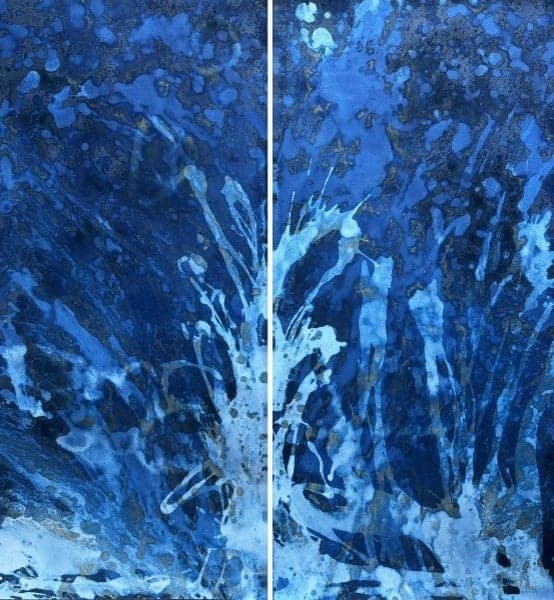
The key to producing blue is the encounter with water. The surface starts out in brown or white tones. When it is soaked again in the water of the river or sea where it was made, a rich gradation of blue appears. The artist adds her hand, and nature responds. Each piece that results from this exchange exists only because of that place and the light and water of that moment. Visitors are invited to imagine the waterside where each blue was born and the landscape behind it.
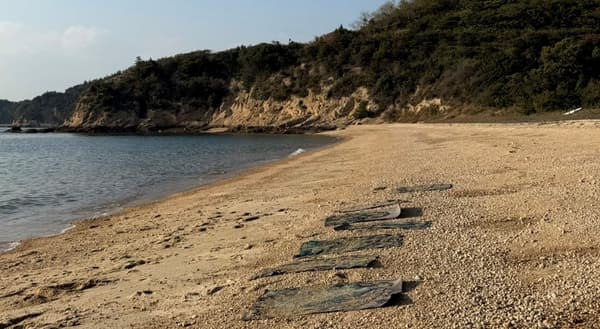
Working on Naoshima, Japan
2. Mino Washi Crosses the Sea and Meets a Hungarian River
The paper used as the base of the works is important to Medcalf. She visited Mino City in Gifu Prefecture, known for its washi, and made washi herself together with local papermakers, creating a sheet of paper by hand from plant fibers and water. She brought the washi back to Hungary and used it to make works on the banks of the Danube and elsewhere. The paper made in Japan is combined with Hungarian river water, light, soil, and natural materials collected locally, and gradually changes into blue works.
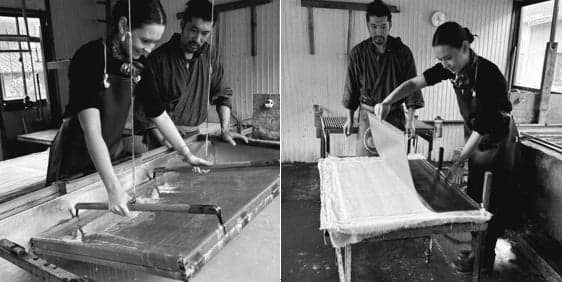
Experiencing washi making in Mino under the guidance of papermaker 千田崇統
The exhibition shows works made with washi from Mino as well as works made with Hungarian handmade paper, including paper from ヴィンツェ紙漉き工房. From the hands that make the paper to the hands of the artist who creates the work, this story of handwork connecting across borders is another highlight of the exhibition.
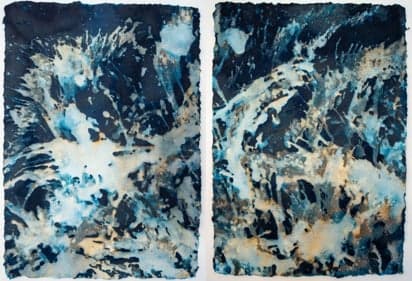
"波の身振り" (2026, Danube River, Hungary), 61 × 44 cm × 2 pieces
3. Traveling Through a World of Blue, from Hungarian Rivers to the Japanese Sea
The exhibition moves from works made on Hungary's Danube and Tisza rivers to works made on Japan's Naoshima and the Seto Inland Sea. Walking through the venue, visitors encounter the blues born at each waterside.
The paper works vary in size and shape. Some tall or wide pieces recall Japanese hanging scrolls and picture scrolls. Two large textile works, similar to noren curtains, gently divide the space and link the displays. Their blue and white call to mind the open sea and sky.
Hungary has a traditional indigo dyeing technique called kékfestés (ケークフェシュテーシュ), and Japan also has a culture of indigo dyeing. Two countries far apart each have a culture of producing blue with water, cloth, and the human hand.
The exhibition title "Nagare" (流れ) carries the meanings of water flowing and of moving forward. The works are the result of Hungarian and Japanese water, soil, light, human hands, and time all coming together. Visitors are invited to take their time at the venue and consider what landscape each sheet of blue reveals.
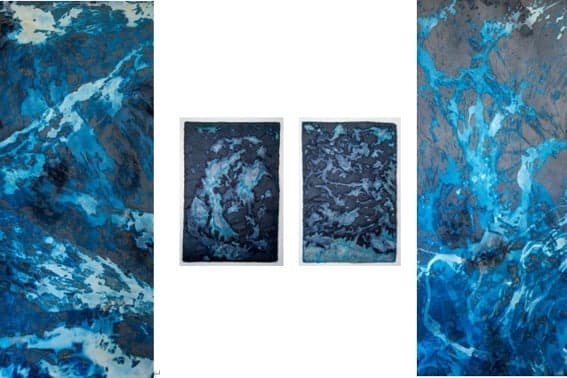
Landscapes of Japan and Hungary, and the sounds of nature, resonate with one another through the various expressions of blue
Related Events (Planned)
Events where visitors can meet the artist and enjoy expressions of water and paper are planned.
Movement of Water: Sumi-nagashi and Hungarian Indigo Dyeing Workshop
Date: Wednesday, November 18, 2026, from 2:00 PM
In this program, participants and the artist create a work together using paper. Participants can try sumi-nagashi (墨流し), a traditional Japanese technique in which a pattern of ink floating on water is transferred to paper. They can also make an original work that incorporates motifs of the traditional Hungarian indigo dyeing technique kékfestés (ケークフェシュテーシュ).
Exploring the World of "In Flow – Nagare" with the Artist: Exhibition Tour and Talk
Date: Thursday, November 19, 2026, from 6:00 PM
The artist guides visitors through the exhibition and explains how the works were created on Hungarian riverbanks and Japanese shores. Visitors can hear about the creation process in each place and the stories behind the natural materials and paper. There will also be an opportunity to ask the artist directly about the works and techniques.
About the Artist
Laura Medcalf (メドカルフ・ラウラ)
Born in 1996 in Budapest, Hungary, Medcalf is a contemporary artist with roots in Hungary and the United Kingdom. Using light-sensitive pigments, river and sea water, and materials collected in nature, she creates work in which nature and the human hand shape the piece together. Her work includes pieces made with Japanese washi and Hungarian handmade paper, as well as spatial expression using textiles. This exhibition is her first solo exhibition in Japan.
Website: www.laura-medcalf.com
Instagram: @laura_medcalf_studio
Exhibition Details
In Flow – Nagare: Solo Exhibition by Laura Medcalf
Dates: Wednesday, November 18, 2026 – Wednesday, March 31, 2027
Hours: 11:00 AM – 5:00 PM (last entry 4:45 PM)
Closed: Saturdays, Sundays, and public holidays in Japan and Hungary. The venue is also closed on the following dates: November 23 (Mon), December 24 (Thu), and December 25 (Fri) in 2026, and January 1 (Fri), January 11 (Mon), February 11 (Thu), February 23 (Tue), March 15 (Mon), March 22 (Mon), March 26 (Fri), and March 29 (Mon) in 2027. The venue is also closed over the year-end and New Year period, and opening information for that period will be announced separately on the website.
Venue: Liszt Hungarian Cultural Center, Cultural Department of the Hungarian Embassy (1F Hibiya Azabu-Juban Building (日比谷麻布十番ビル), 3-8-1 Azabu-Juban, Minato-ku, Tokyo)
Access: 3-minute walk from Azabu-Juban Station on the Tokyo Metro Namboku Line
Contact: Tel: 03-6459-4931 (main)
Please note that the content and dates may change without notice.