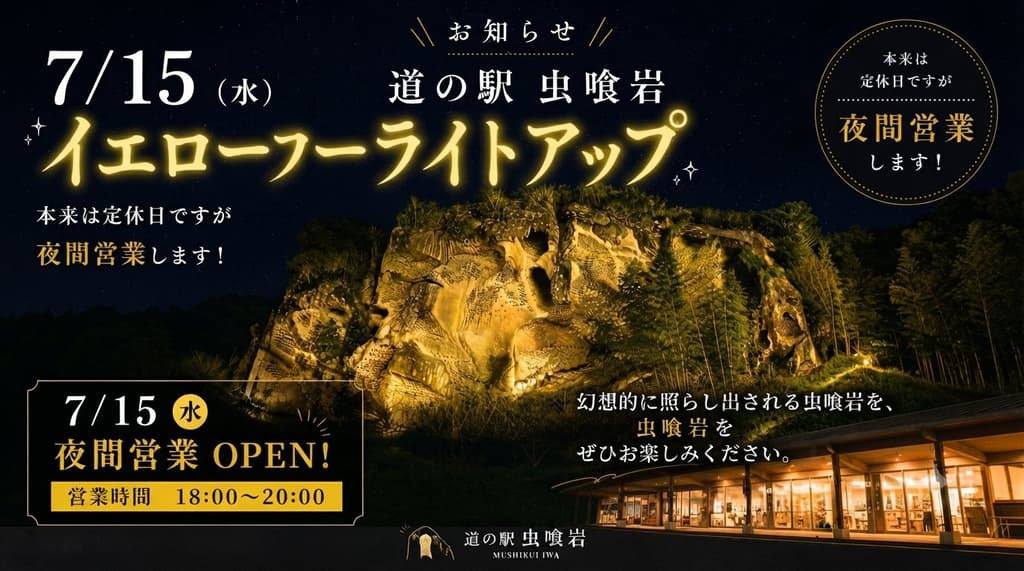
The Kozagawa Town Tourism Association (Kozagawa-cho, Higashimuro-gun, Wakayama Prefecture) is holding a one-night event on Wednesday, July 15, 2026, from 6:00 PM to 8:00 PM: a yellow light-up of the nationally designated natural monument Mushikui-iwa, paired with a special evening opening of the roadside station Michinoeki Mushikuiiwa. Alongside the fantastical night view of the rock, visitors can pick up Kozagawa specialties such as yuzu products and gibier for one evening only.
Event Overview
- Event: Mushikui-iwa Yellow Light-Up & Michinoeki Mushikuiiwa Night Opening
- Date & Time: Wednesday, July 15, 2026, 6:00 PM to 8:00 PM
- Venue: Mushikui-iwa (705-1 Ikenoyama, Kozagawa-cho, Higashimuro-gun, Wakayama 649-4103)
- Organizer: Kozagawa Town Tourism Association
- Admission: Free (free parking)
- Who can attend: Open to everyone, no reservation needed, free entry and exit
A Nationwide Movement, Told Through Light and Nature
The light-up ties into the "Movement to Brighten Society," a nationwide campaign that promotes crime prevention and community support for rehabilitation. Using the movement's signature color, yellow, the event lights up the nationally designated natural monument "Takaike no Mushikui-iwa," linking it with the everyday gathering spot Michinoeki Mushikuiiwa to let visitors experience a "bright community" through sightseeing, nature, and food.
Highlight 1: A Yellow Light-Up of the National Natural Monument Mushikui-iwa
Takaike no Mushikui-iwa is a nationally designated natural monument and one of Japan's 100 Selected Geological Sites. Countless holes carved by wind and rain erosion, called tafoni, cover the rock's surface, and lighting it up at night brings out its distinctive forms in dramatic relief.
- The tafoni-covered rock face rendered in yellow light
- Shadows and depth not visible during a daytime visit
According to local tradition, the rock can cure ear ailments, and visitors thread string through small holes in stones to make a wish; a Kannon hall built into the rock holds many stones left as offerings. Under the light-up, the area's long-held customs of prayer and its natural forms come together.
Highlight 2: Yuzu, Gibier, and Honey at Michinoeki Mushikuiiwa's Night Opening
For the event, the roadside station Michinoeki Mushikuiiwa will open specially at night, giving visitors time to browse Kozagawa's specialty products alongside the light-up.
Yuzu
Kozagawa Town is known for its fragrant yuzu. Kozagawa Yuzu Soda, only available locally, offers a refreshing aroma and gentle tartness suited to the season, and is best enjoyed while taking in the illuminated rock.
Gibier and honeybee products
Surrounded by mountains, Kozagawa has a long history of hunting and beekeeping with Japanese honeybees. Venison and wild boar gibier, along with honey and beeswax products from Japanese honeybees, are among the town's specialties.
Highlight 3: A Gentle Approach to Nighttime Tourism
The event combines nighttime tourism centered on a national natural monument with the town's everyday food culture, aiming to share Kozagawa's appeal while being mindful of the natural environment.
- Mushikui-iwa is part of the Kozagawa arc-shaped dike, formed by weathering and erosion of what was once the underground portion of the Kumano caldera roughly 15 million years ago
- Spreading visits into the evening helps balance tourism with daily life in the area
How to Join, Access, and Notes
How to join
No reservation is required, and anyone is welcome to attend. Both admission and parking are free.
Access
- About 10 minutes by car from JR Kisei Main Line's Koza Station
- About 50 minutes by car from Susami-Minami IC on the Kisei Expressway
- About 1 hour 15 minutes by car from Kumano-Odomari IC on the Kisei Expressway
- Free parking is available at Michinoeki Mushikuiiwa (limited spaces)
Notes
- Some areas underfoot are dark, so wear comfortable, sturdy shoes
- For safety, do not enter the rock face or any area marked off-limits
- Nights can be cool, so bring something to layer