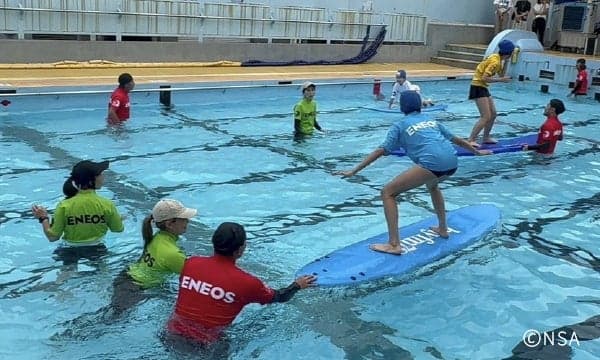
The Japan Surfing Association (NSA) has announced the formalization of its pool-based surfing education program for children. After approximately eight years of hands-on practice, NSA has systematized the initiative as a structured educational program. It is designed so that even children with no surfing experience can safely achieve the success of standing on a surfboard, and it is drawing attention as a new model for sports and community education.
Background: The Challenge of Drop-Outs After a First Try
While surfing is an appealing sport, many beginners drop out after their very first attempt due to fear of the ocean, frustration from being unable to stand up, and reluctance about the environment — seawater, sunburn, and so on.
Solution: Delivering a "Success Experience" First
NSA's answer was to bring surfing into the pool. In the safe, wave-free environment of a swimming pool, participants first experience standing up, feel the joy of the sport, and build confidence — a "success experience" delivered before they ever enter the open ocean. This approach has significantly lowered the psychological barrier to surfing.
Educational Approach: "Teaching Without Teaching"
The program's defining characteristic is an approach quite different from conventional sports instruction:
- Surfing terminology is not used
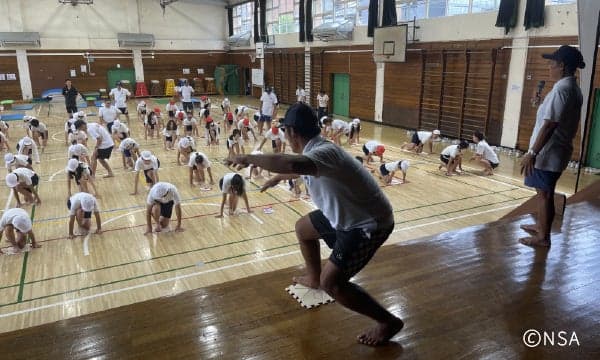
- Understanding is developed through physical sensation
- Fun is the top design priority
Using balance mats and simple tools, the curriculum helps children grasp balance as a bodily sensation. Sessions make use of props such as two-sided boards marked with circles and Xs, guiding participants to understand balance intuitively.
Origins: The Philosophy of Doji Isaka
At the heart of the program lies the philosophy of Hiromi Isaka, known as Doji Isaka — a legend of Japanese surfing who won the Men's Class at the 4th All Japan Surfing Championship and expanded Japan's first year-round beach community, "Beach Club," nationwide. Over 70 years, Isaka pursued the question of how to help anyone enjoy surfing, building a philosophy of "surfing that anyone can enjoy." NSA inherited that vision and developed the program under the principle of "transforming a difficult sport into something everyone can experience."
"Surfing is a difficult sport. But if someone has that first success — 'I stood up' — they can keep going on their own from there. We believe the value lies in creating that moment of zero becoming one."
— Yoshihiko Utsumi, NSA Education Committee Chair
Educational Value
The program goes beyond a simple sports experience. Confirmed educational benefits include:
- Improved self-esteem
- Development of bodily awareness
- Cultivation of a willingness to take on challenges
In particular, it contributes to improved balance sense and body awareness — skills that are often underdeveloped in today's children due to limited physical activity.
Social Significance and Future Plans
The program aims to:
- Expand access to sports participation
- Rebuild the relationship between local communities and the ocean
- Broaden the base of surfing culture
Through partnerships with educational institutions and local governments, the curriculum has begun to be incorporated into school lessons. NSA plans to strengthen ties with boards of education across Japan, support the integration of the program into school curricula, and combine it with regional sports development initiatives. The long-term vision is to establish an educational model that enables surfing experiences even in inland areas with no access to the ocean.