Italian luxury house FENDI has introduced the FENDI Design Prize, a new initiative celebrating design and craftsmanship while discovering and nurturing emerging talent. Conceived in the spirit of the maison's longstanding legacy of fostering innovation and supporting the next generation, the award is curated by designer Giulio Cappellini and judged by a distinguished international panel including Cristina Celestino, Joseph Grima, Neri & Hu, Rossana Orlandi, Josh Owen, and Patricia Urquiola.
The 2026 finals took place in April during Milan Design Week at the FENDI Casa boutique on Piazza della Scala in central Milan. From six finalists, Gustav Craft's "VIA" was chosen as the inaugural winner.
FENDI Chairman and CEO Ramon Ros stated: "We are thrilled to announce the FENDI Design Prize. FENDI has historically nurtured many talents. Through this new initiative, we hope to continue building that inspiring journey. The new generation from around the world inspires us greatly with their vision of how to interpret the maison's codes. And we look forward to meeting the next outstanding designer who will shape the future."
The winning project is set to be realized and presented at Design Miami in December 2026. In 2027, an opportunity will be given to create a collection or a curated group of works in collaboration with FENDI Casa.
The open call received over 70 submissions, with specific briefs sent to leading design schools around the world. Applicants were asked to propose a living space comprising multiple elements including furniture and accessories, with both individual and group entries welcomed. Key selection criteria included the integration of upcycled FENDI leather and fur, along with elements emblematic of the maison—such as "Selleria," the brand's color palette, inspiration drawn from Rome, and a commitment to exceptional craftsmanship.
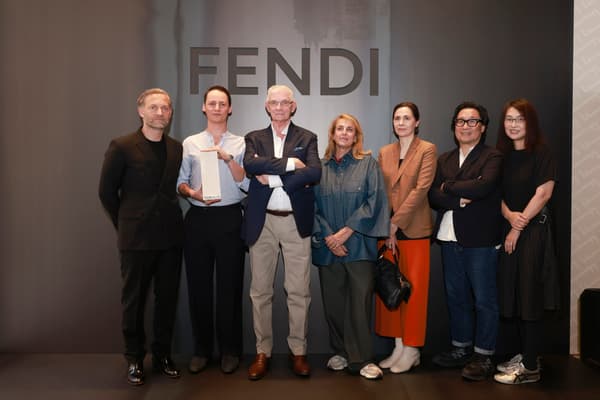
Jury Comments
Giulio Cappellini
"This project most accurately expresses FENDI's modernity while respecting tradition. Past forms are projected into the future, and technology and craftsmanship are beautifully fused to create a product with a powerful image that enriches diverse spaces."
Cristina Celestino
"The winning project interpreted the theme with the freshest and most free-spirited imagination. What I feel strongly about is the importance of maintaining a curious, open attitude throughout the entire creative process. For me, research is a place of possibility—an opportunity to keep receiving rather than closing off. In this sense, technology like AI should serve ideas, not replace them."
Joseph Grima
"Often, 'decoration' itself is mistaken for 'meaning.' But Gustav Craft's work set itself apart from this tendency with a quieter, more refined proposal. His work delicately incorporates the elements that make up Rome's streetscapes without ever expressing them overtly. And rather than directly imitating the best aspects of Italian rationalism, his expression evokes its spirit with confidence. The other finalists also demonstrated a deep understanding of traditional craftsmanship and a rich imagination for how that tradition might evolve in the innovation-driven 21st century. The overall level was extremely high, and selection was not easy—but this also shows that the new generation today is actively embracing traditions and modes of expression that are generally thought to hold little interest for younger audiences."
Josh Owen
"In my view, the finalists all responded to the competition's theme of cultural creation with curiosity and creativity. Among them, Gustav Craft's 'VIA' stood out for its deep connection to Rome's fundamental materiality—beautifully capturing the textures of the 'Eternal City,' where antiquity and modernity coexist."
Finalists' Projects
"VIA" — Gustav Craft
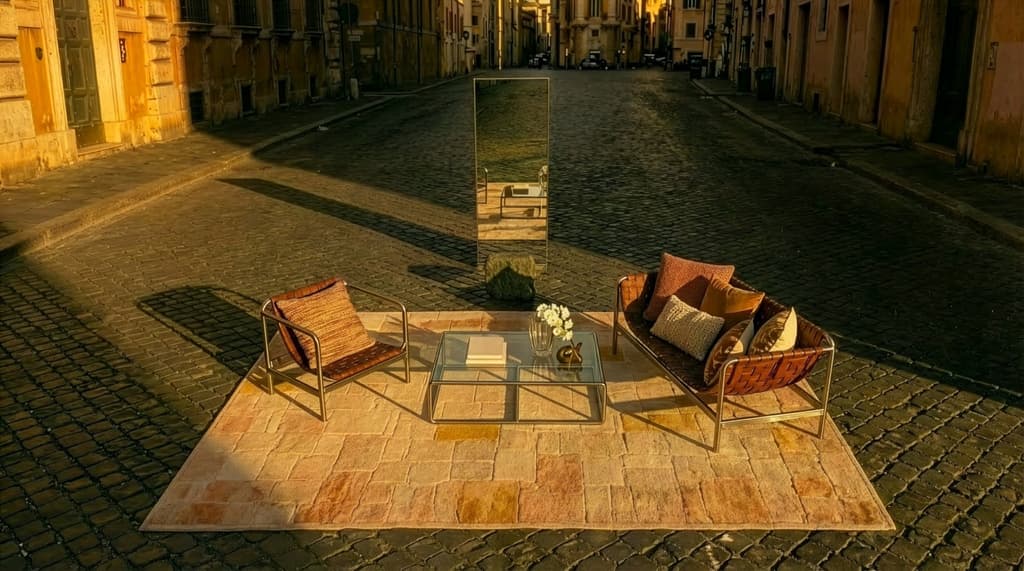
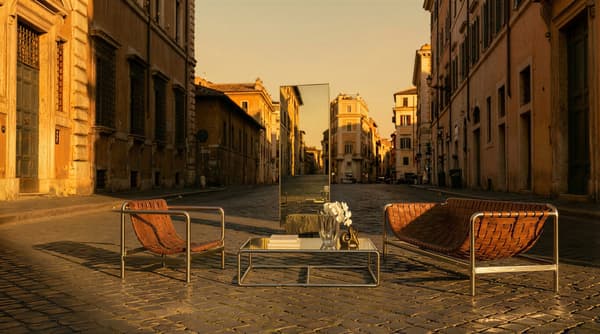
Everyone who visits Rome walks on these stones without knowing their name. "VIA" begins there. The "sampietrini"—small basalt stones that have paved Rome's streets for 2,000 years—lay underfoot for legionnaires, merchants, and lovers, yet were seldom consciously noticed. But this is the truth of the most intimate and most essential material of the city of Rome. "VIA" translates that truth into a furniture collection. The woven leather seat represents Rome's roads, each strap a stone, each crossing an intersection. The steel frame follows a surveyor's grid, with weld marks deliberately left exposed at the joints. The rug bears the appearance of Rome's streetscapes—worn by centuries of life—as seen from above, while the mirror places a blade-thin steel frame atop a single roughly cut sampietrino block. The heaviest material in the collection supports the lightest element. Every object poses a single question: What does it mean to create something that endures?
"TEMPUS AUREA" — Mimisol Arjona, Hugo Cleve, Luc Hodge, Valeria Lupo, Dhruv Vyas
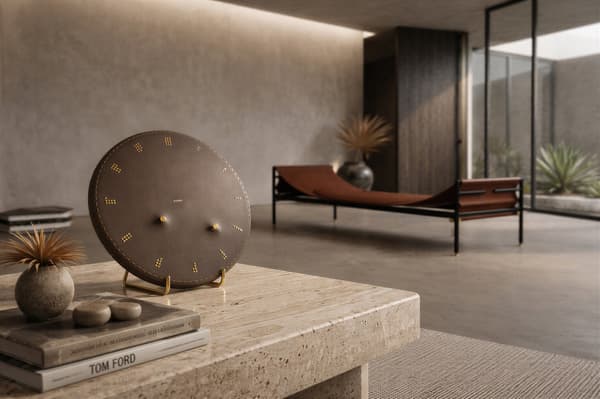
"Tempus Aurea" (Golden Time) is a collection of two objects that reinterpret ancient Roman domestic rituals through the material and stylistic DNA of Maison FENDI. Rooted in the relationship between time, light, and everyday life, it draws inspiration from the Roman solarium (sun room) and lectus (reclining couch)—objects that were both functional tools and cultural devices. "Solarium" transforms a sundial into a leather-clad wall clock, letting time be perceived not through numbers but through texture and shadow. "Otium" reinterprets the lectus as a lounge bench, creating a space for rest, reflection, and contemplation through a single piece of tensioned leather. Together, the two objects generate a dialogue between "measuring time" and "living time"—where luxury emerges not through excess but through restraint: the will to pause, observe, and be present in the moment.
"VELARE CAPSULE COLLECTION" — Mahla Mustafa
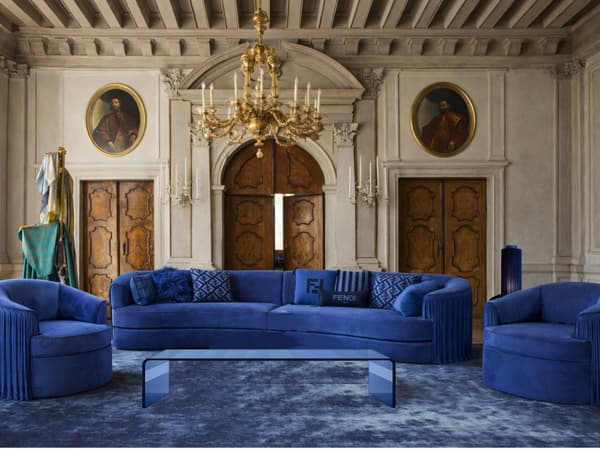
In Rome, history never appears in complete form. It presents itself as light sliding between columns, shadows stretching across stone—fragments of moments felt as sensation rather than seen by the eye. "Velare" begins in that suspended space. For FENDI Casa, rooted in the language of Rome, this collection does not return to a fixed past or monumental history. Instead, by interposing a veil, it filters, reconstitutes, and allows heritage to exist in a new contemporary form. Through this gesture, architecture dissolves into air. The rigid rhythm of Rome's colonnades is transformed into soft, continuous, moving fringe, and structure becomes tactile and vital. Surfaces curve, contours blur, and light is captured, diffused, and released. The deep blue palette evokes the quiet intensity of Rome at dusk—when the city shifts from presence to memory—giving the collection depth and permanence. Materials such as suede and glass further expand this idea, creating layers of perception rather than a single form by absorbing and reflecting light. Rather than simply imitating Rome's history and architecture, the project interprets Rome's elements in its own way, translating them into design in a new form. Heritage is no longer something to be exhibited, but something to be experienced through movement, light, and touch.
"ROVINE" — Samina Ilyas, Isabella Maria Motta Gallego
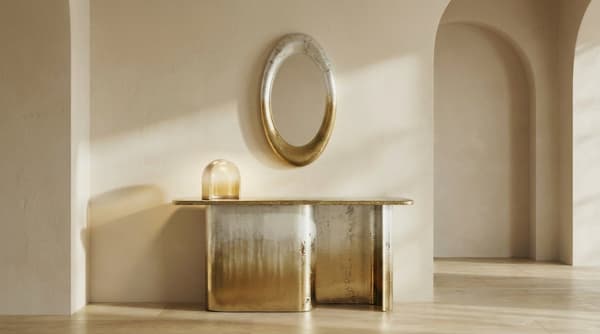
"Rovine" is a design collection that brings fragments of Rome into living spaces, translating the texture and presence of its ruins into contemporary forms. The project evokes "anemoia"—a nostalgia for places one has never personally experienced but that nonetheless move the soul deeply. A key material approach in this collection is the technique of silver ring mirroring: treating reflective surfaces and partially eroding them to create a wavering in the perception of form. Through this technique, architectural fragments are reflected, distorted, and transformed within the mirror into a device for reconstruction through absence. Drawing on Giovanni Paolo Panini's depiction of the Pantheon interior—referenced in studies of art history—the collection confronts the light and geometry of the Pantheon. Classical elements are reinterpreted from a deconstructive perspective; forms are fragmented, layered, and slightly displaced to elicit the interplay of light and structure. These works bring the memory and atmosphere of Rome into the home, transforming history not merely as reference but as something quietly lived through reflection, fragment, and light.
"CONVIVIUM" — Pierferdinando Arcella
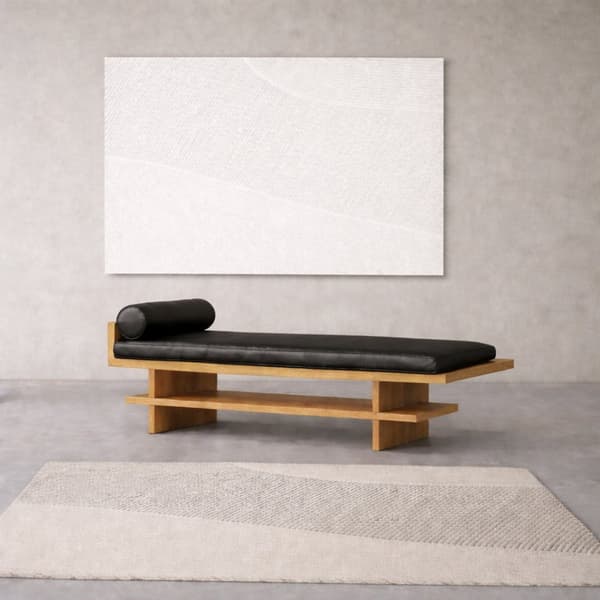
Born from the memory of the Roman convivium—a Latin term for banquet and communal dining—and transforming it into a contemporary experience, this object draws inspiration from the rituals of the lectus and triclinium to reinterpret the act of sharing as a form that is both essential and evocative. To reinterpret the convivium is to reinterpret our roots: looking at history as a living material capable of transformation, and creating a new elegance and way of sharing. The object finds a new identity within the universe of FENDI, becoming a bridge between past and present.
"FENDI FITNESS KIT" — Muskan Agarwal, Mathilde Brambilla
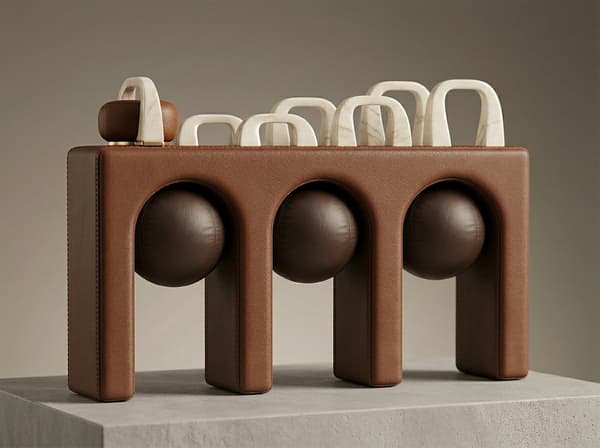
Contemporary homes are evolving into multifunctional spaces where wellness becomes part of daily life. Yet a gap remains between purely functional fitness products and static luxury decorative pieces. This project proposes a new category to bridge that divide—sculptural luxury objects that transform into workout tools. Inspired by Roman architecture and the codes of FENDI, the design seeks a fusion of function and decoration. Fitness is no longer something to be hidden, but rather something integrated into living spaces as an intentionally visualized presence with emotional appeal.