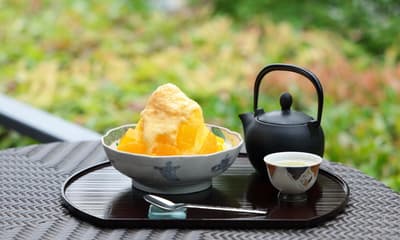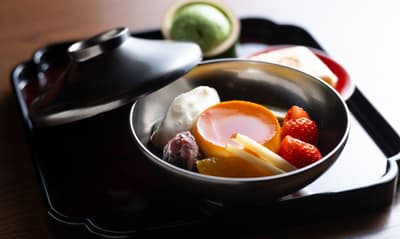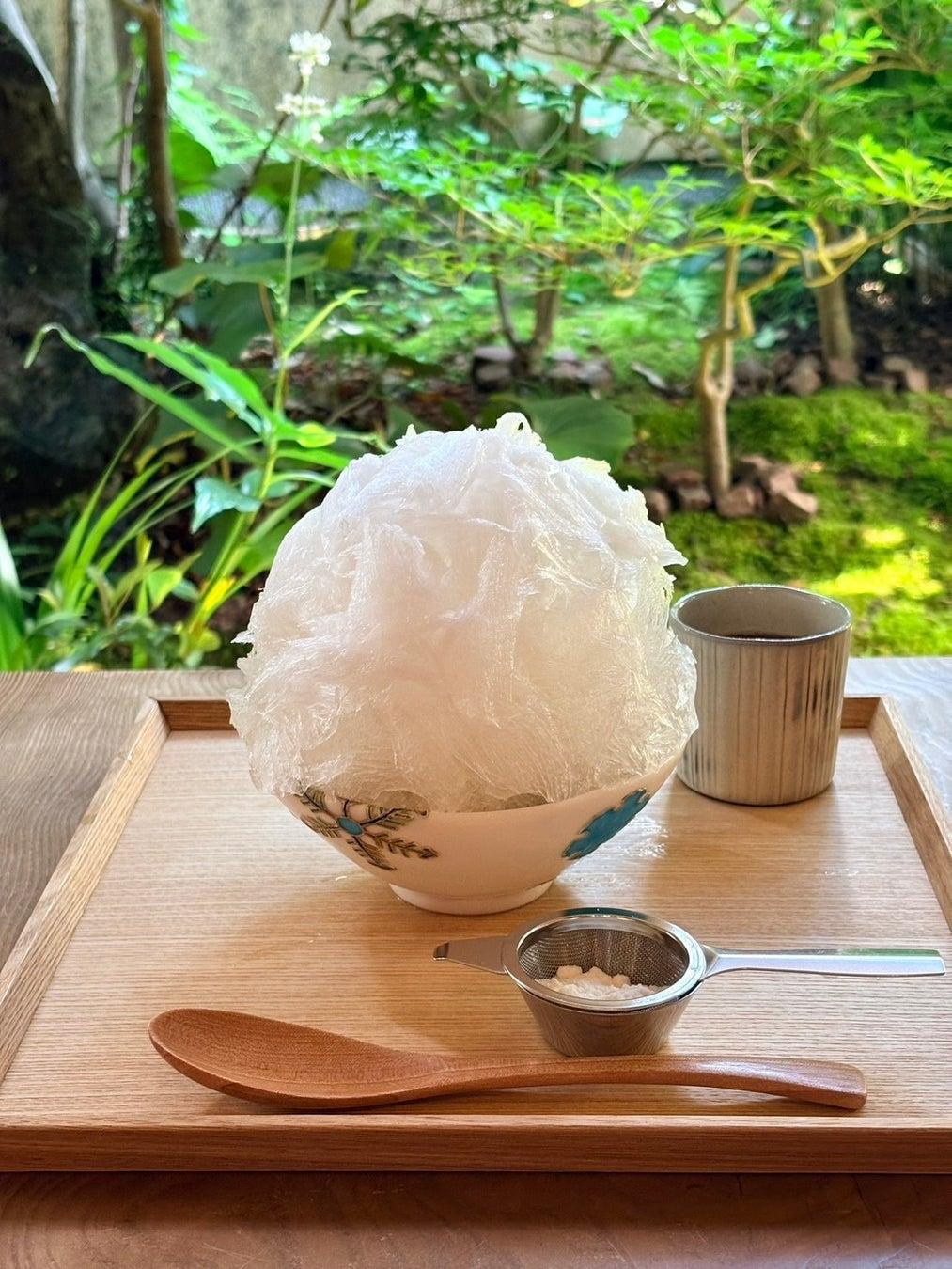
"Shaved ice with amazura added —"
A passage in The Pillow Book (Makura no Soshi) describes a luxury of summer: Heian-era aristocrats savoring precious ice sweetened to taste.
Oimatsu (老松), a Kyoto wagashi maker, is now expressing that thousand-year-old world of "shaved ice" as a modern confection, serving a summer-only shaved ice at Chabo 玄以庵, the tearoom of its Arashiyama shop.
It's made with natural ice from Yondaime Tokujiro, an ice house in Nikko, Tochigi Prefecture, paired with top-grade wasanbon sugar from Tokushima Prefecture.
Because it's shaved ice from a wagashi maker, Oimatsu designed it not as "a cold dessert with syrup poured over it," but as a single confection where the ice, sweetness, and aroma come together as one.
Why Oimatsu Makes Shaved Ice
Oimatsu, headquartered in Kamigyo-ku, Kyoto, has begun offering the summer-only shaved ice made with Nikko's "Yondaime Tokujiro" natural ice at Chabo 玄以庵, the tearoom of its Arashiyama shop.
In the Heian-era imperial court, ice stored in a himuro (ice house) was presented and eaten on the first day of the sixth month of the old lunar calendar, a seasonal ritual to help ward off the summer heat.
Wanting to carry that centuries-old custom into the present, Oimatsu's craftspeople went through repeated trial and error, and what they arrived at was a recreation of the ice described in The Pillow Book.
The core ingredient is natural ice from "Yondaime Tokujiro" in Nikko, Tochigi Prefecture.
Because it's grown in a natural ice house, supply is limited, making it a flavor to enjoy only for the summer season.
The mizore syrup poured over the shaved ice uses rare, hard-to-find top-grade wasanbon sugar from Tokushima Prefecture.
The Rigors of Natural Ice-Making, Learned on Site
The natural ice used in the shaved ice is made at the "Yondaime Tokujiro" ice house in Nikko, Tochigi Prefecture.
To understand how the ice is made, Oimatsu staff traveled to Nikko repeatedly and took part in the actual ice-making process.
Clearing snow off the surface of the ice pond, adjusting the ice's care as the weather changes — by experiencing firsthand an environment set against the harsh cold of nature, they learned that natural ice isn't produced uniformly by machine, but comes into being only where a craftsperson's experience and natural conditions align.
Having taken part in the ice-making themselves, Oimatsu came to see natural ice as "a material that carries a craftsperson's work."
That's why they think through everything from the ice itself to how it's paired with the top-grade wasanbon with the same care as making wagashi.
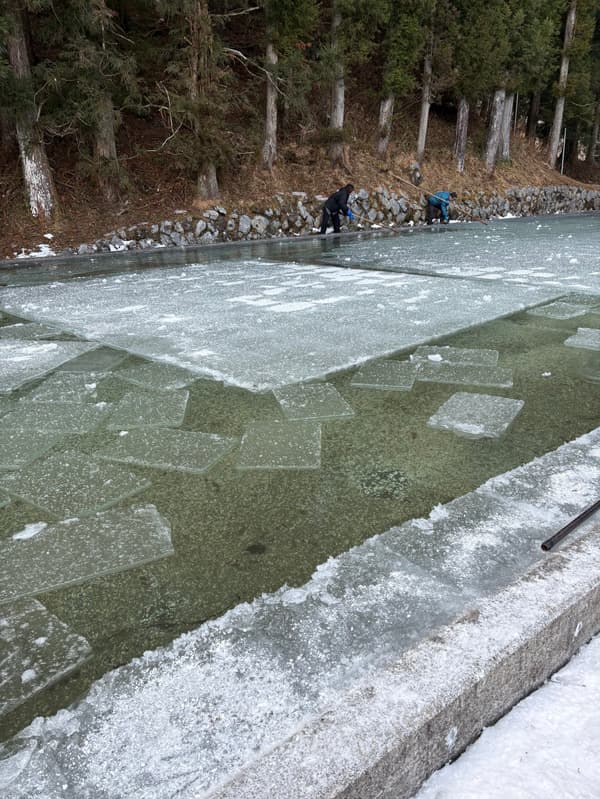
Ice-making
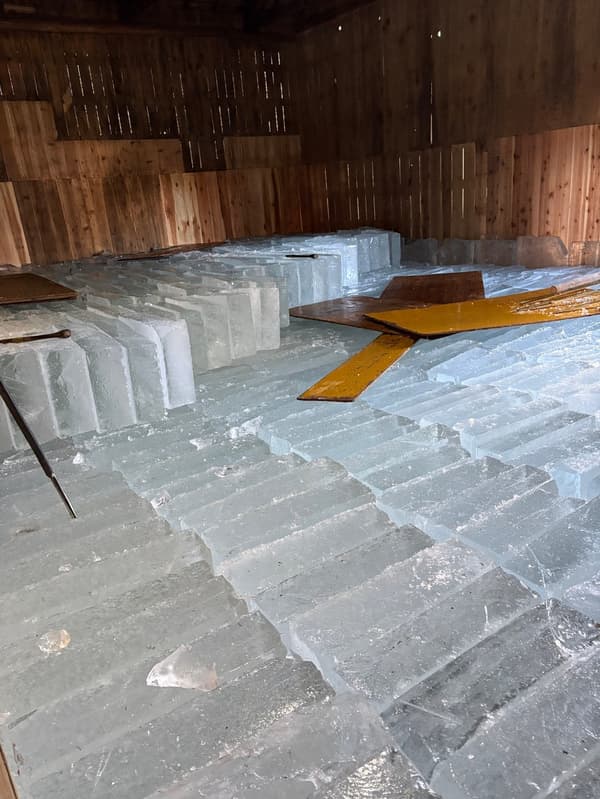
Ice at the ice house
Why Tokushima Wasanbon
The sweetness paired with the ice is top-grade wasanbon sugar from Tokushima Prefecture.
Wasanbon itself carries a distinctive aroma along with an elegant sweetness that fades smoothly on the palate.
Oimatsu didn't think of the shaved ice's sweetness as "syrup to make it sweeter," but as a confectionery element to be savored together with the ice's melt.
The aim was to avoid disturbing the natural ice's delicate melt-in-the-mouth quality, while still letting the distinctive aroma of wasanbon come through the moment it touches the tongue. Drawing on experience built through wagashi-making, Oimatsu chose the sugar with an eye to how well it pairs with the ice.
Tokushima wasanbon is what it settled on.
The wasanbon sugar is sprinkled on right before serving.
This isn't to make the sweetness stand out more strongly.
It's to bring out the elegant, gentle aroma of the wasanbon more fully.
As the wasanbon touches the ice and dissolves in the mouth, its distinctive aroma rises up. Guests can savor both the ice's changing texture over time and the aroma at the moment it touches the tongue.
Tanba Dainagon Azuki, Cooked by Hand for Aroma and Texture
The chunky red bean paste served with the shaved ice uses large-grain Tanba Dainagon azuki beans.
Tanba Dainagon azuki are notable for being large yet resistant to splitting even after being cooked, so each bean keeps its presence and a plump texture. That makes the beans a pleasant accent even alongside the delicate melt of the natural ice.
Oimatsu's craftspeople carefully cook this Tanba Dainagon azuki by hand.
In typical bean-paste making, a step called "shibukiri" removes the beans' astringency, but for the chunky paste used with this natural-ice shaved ice, Oimatsu deliberately keeps that step light, in keeping with the ice. This draws out the beans' full natural aroma, so their flavor still comes through clearly amid the gentle sweetness of the natural ice and wasanbon.
Nikko's natural ice, Tokushima's wasanbon, and Tanba Dainagon azuki — Oimatsu brings each ingredient's character together in harmony within a single bowl, drawing on the skill and sensibility built through its wagashi-making.
Product Overview
Name: Natural Ice Shaved Ice "Mizore"
Price: ¥2,970 (tax included)
Availability: Until the natural ice runs out
Store Information
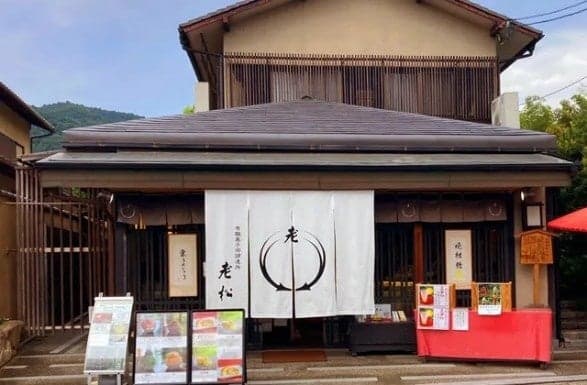
Oimatsu Arashiyama
Store Name: Oimatsu Arashiyama, Chabo 玄以庵
Phone: 075-881-9033
Address: 20 Saga-Tenryuji Susukinobabacho, Ukyo-ku, Kyoto 616-8385
Hours: 9:00 AM to 5:00 PM (Tearoom: 9:30 AM to 5:00 PM, last order 4:30 PM)
Closed: Irregularly