Park Hyatt Kyoto, located in the Higashiyama district, is teaming up with Chefs for the Blue — a chef collective dedicated to sustainable seafood and ocean conservation — to host "Sustainable Seas, Kyoto Table" on Tuesday, July 7, 2026. The special dinner will take place at the hotel's signature restaurant "Yasaka" on the 4th floor, as part of the hotel's "Masters of Food & Wine" program.
What sets this event apart is that it goes well beyond a one-night collaboration. Over the course of approximately six months, Chefs for the Blue conducted a training program for roughly 30 members of Park Hyatt Kyoto's Food & Beverage team, covering the state of marine resources and Japan's fish-eating culture. Three chefs from Yasaka also participated in field visits to the fixed-net fishing grounds in Ine, Yosa-gun, Kyoto Prefecture, and to the Miyazu Bay area. The event serves as the culmination of that joint learning — a single evening's menu that distills half a year of discovery.
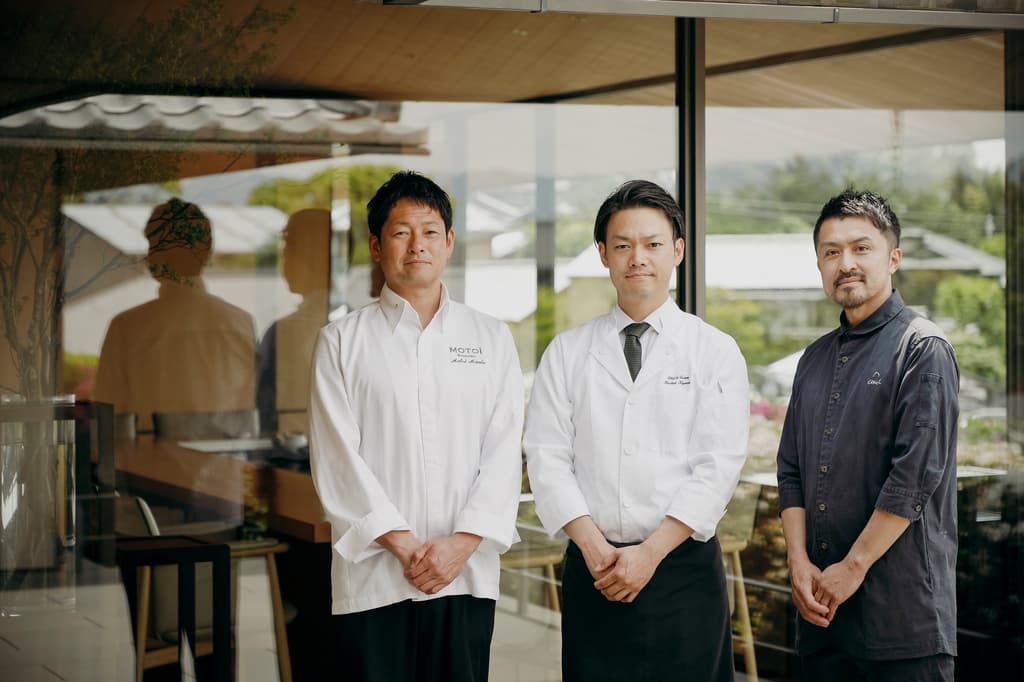
On the night of the event, Yasaka's head chef Kentaro Koyama will be joined by Chefs for the Blue Kyoto members Ken Sakamoto (cenci) and Motoi Maeda (Restaurant MOTOÏ) for a six-hands, 8-course dinner.
Highlights
A hotel sustainability initiative rooted in training, not just a single event
Rather than a one-off collaboration, approximately 30 F&B team members engaged in study sessions, then carried that knowledge forward into everyday practice. The event marks a first step toward embedding sustainability across the entire hotel.
An 8-course "Six-Hands" dinner reflecting Kyoto's seafood culture
Head chef Koyama (Yasaka), Ken Sakamoto (cenci), and Motoi Maeda (Restaurant MOTOÏ) each bring their own interpretation to Kyoto's fish-eating heritage — teppanyaki-meets-French, Japanese-ingredient Italian, and cuisine rooted in the Kansai fishing landscape — all on one table, in one evening.
Eco-certified bluefin tuna, used whole
The menu incorporates cuts rarely found in mainstream distribution — stomach, heart, and head meat — allowing guests to experience nose-to-tail cooking in practice.
Kyoto seafood from Ine's 400-year-old fixed-net fishing and Miyazu Bay
The chefs visited these fishing sites firsthand. The resulting dishes feature local ingredients such as the Ootori clam, raised exclusively in Miyazu Bay.
The restaurant as a medium
Guests enjoy exceptional food while learning about the state of the ocean behind it — an effort to share stories and encourage sustainable choices beyond the dining room.
Event Details
| Date | Tuesday, July 7, 2026 |
| Venue | Yasaka, Signature Restaurant, 4th Floor, Park Hyatt Kyoto |
| Address | 360 Masuyacho, Kodaiji, Higashiyama-ku, Kyoto |
| Price | ¥33,000 (8 courses) / Alcohol pairing ¥17,250 / Non-alcohol pairing ¥6,900 (all tax included, service charge extra) |
Schedule:
- 6:30 PM – Doors open (Reception on the 4th-floor terrace: canapes and champagne with a documentary screening covering the project's journey; reception food and drink included in ticket price)
- 7:00 PM – Dinner begins
- 9:00 PM – Dinner concludes
Reservations accepted up to 7 days before the event. Menu is subject to change based on availability. Schedule may vary on the day. Cancellations made 7 days or fewer before the event are subject to a 100% cancellation fee. Non-alcoholic pairings are available upon request at the time of booking. In the event of rain, the reception will be held in an alternative indoor venue within the hotel.
Reservations: Yasaka Restaurant Website / Book Here
Course Menu (Selected Dishes)
Head chef Kentaro Koyama began questioning whether it was enough to simply serve delicious Kyoto ingredients to guests from around the world. After attending a Chefs for the Blue workshop in Kyoto, he developed a strong awareness of marine resource sustainability — and wanted to share that learning with his hotel team. That sense of purpose became the starting point of this project.
The 8-course menu expresses Kyoto's sea and culinary heritage, united by the three chefs' shared commitment to passing on sustainable fish-eating culture to the next generation. Four representative dishes are introduced below.
Amuse-Bouche: Eco-Certified Atlantic Bluefin Tuna, Three Ways
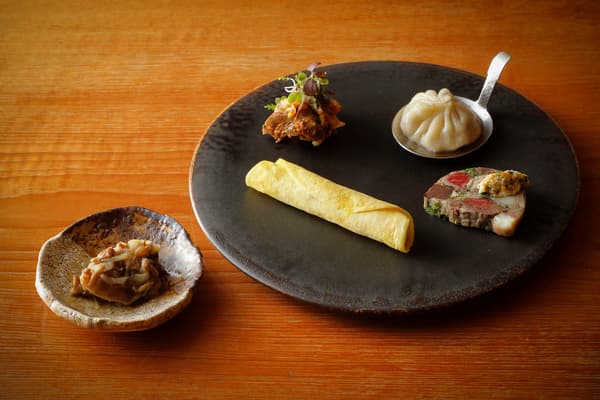
An internationally eco-certified Atlantic bluefin tuna is used in its entirety. Chef Koyama fashions head meat, stomach, and smoked heart into a terrine seasoned with parsley and Japanese pepper — French technique applied to Japanese fish culture. Chef Sakamoto draws inspiration from the South Indian fermented crepe "dosa," harmonizing fermented acidity with spice in a braised tail preparation. Chef Maeda, with experience in Chinese cuisine, dresses the stomach in a house-made doubanjiang aged two years, black vinegar, and green Sichuan pepper, then wraps the fatty collar meat into a xiao long bao. Three distinct expressions, one dish.
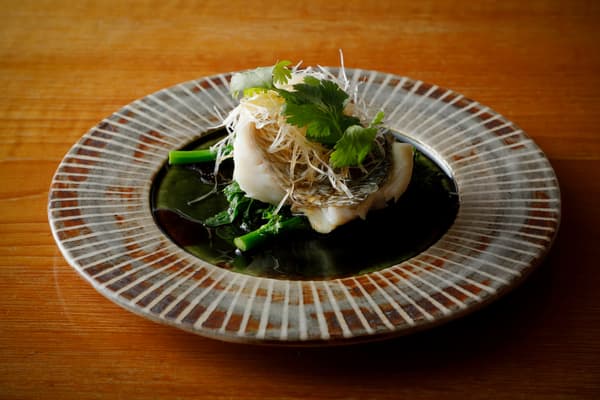
Steamed Fish from Ine's Fixed-Net Haul, Cantonese Style (Chef Maeda)
Seasonal fish caught from Ine's fixed-net fishery is gently steamed with vegetables, then finished with a topping of hot-oil-fragrant white scallions and cilantro and a soy-and-fish-sauce-based dressing that brings out the natural flavor of the catch. Because fixed-net fishing means chefs never know exactly what will arrive each day, Chef Maeda sees it as a discipline requiring extensive knowledge and culinary versatility — and that spirit is evident in this dish.
Biwa Trout, Yogurt and House-Made Funazushi, Kaffir Lime Oil and Cucumber (Chef Sakamoto)
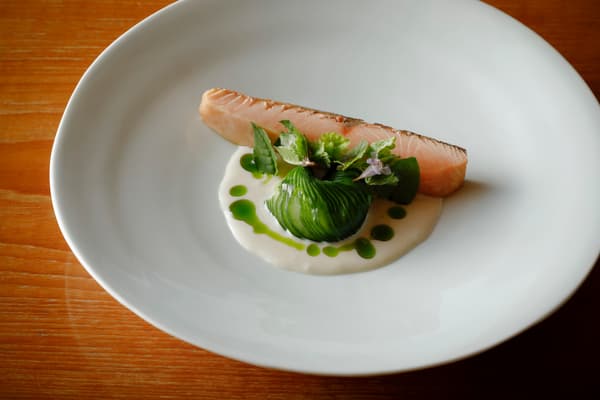
Lake Biwa's endemic Biwa trout is cooked so the skin is crisp while the flesh falls apart gently. The sauce uses drained yogurt blended with rice from a two-year-aged funazushi (fermented crucian carp), bringing layered umami and a mild acidity. Kaffir lime leaf oil and thinly scored cucumber add freshness, tying together the richness of fermentation and dairy with the delicate flavor of lake fish.
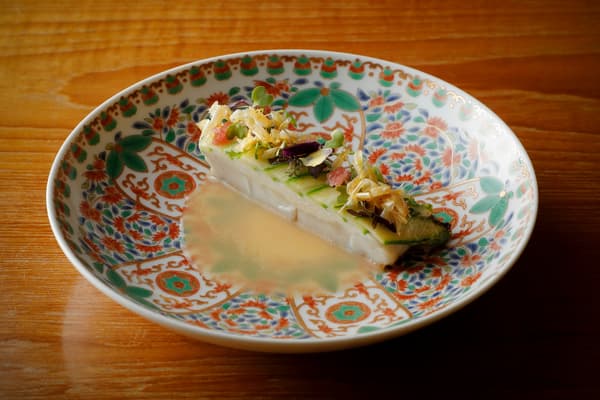
Amadai (Tilefish), Fish Mousse Medley, and Ine Mankai Beurre Blanc (Chef Koyama)
Long cherished in Kyoto as "guji," the amadai in this dish comes from the coastal waters around Ine, Miyazu, and Kyotango. Paired with zucchini from local Aoki Farm and a classic mousse made from various fish caught in their own fixed-net operation, the dish consciously reflects regional cycles. The skin-side-crisped tilefish sits alongside a beurre blanc prepared with "Ine Mankai" sake from Mukai Shuzo in Ine — a local sake known for its distinctive flavor — amplifying the fish's natural sweetness. Chef Koyama describes the dish as an effort to remind Kyoto residents of just how good Kyoto fish can be.
Training Program
Prior to the event, Chefs for the Blue conducted a six-month training program (two classroom sessions and two field visits) for approximately 30 members of Park Hyatt Kyoto's Food & Beverage team.
Training Session 1: History of Fish-Eating Culture and Japanese Food Culture (February 6)
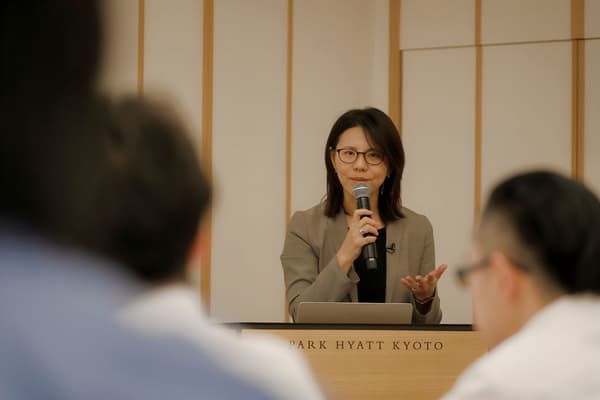
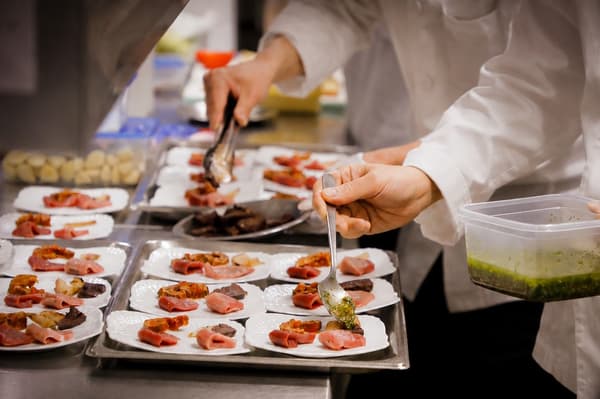
Food journalist and Chefs for the Blue representative Hiroko Sasaki gave a lecture covering the history of Japan's fish-eating culture, traditional fishing methods, the recent rapid decline in marine resources, and the differences between fisheries management policies in Europe, the United States, and Japan. Participants also sampled rarely distributed cuts — stomach and heart — from eco-certified Atlantic bluefin tuna, providing a hands-on prompt for younger chefs and service staff to consider their own actions.
Fieldwork 1: Fixed-Net Fishing in Ine (March 2)
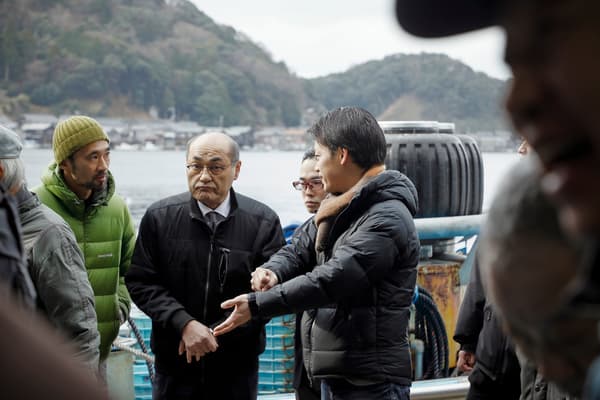
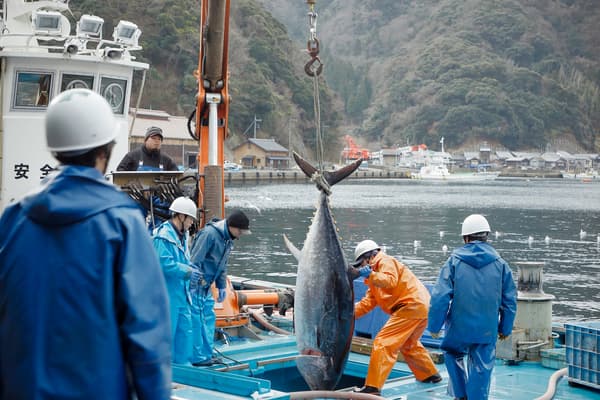
Head chef Koyama and the Yasaka chef team traveled to Ine, Yosa-gun, Kyoto Prefecture, to learn firsthand about the fixed-net fishing method — a tradition spanning some 400 years that is characterized by waiting for fish rather than actively pursuing them. The team also gained insight into declining catch volumes in recent years and the challenges ahead. Experiencing the diversity of the catch and tasting freshly grilled tuna heart over a wood fire on the fishing boat, the chefs discovered new appreciation for cuts that rarely reach the market.
Fieldwork 2: Bivalve Aquaculture in Miyazu Bay (Same Day)
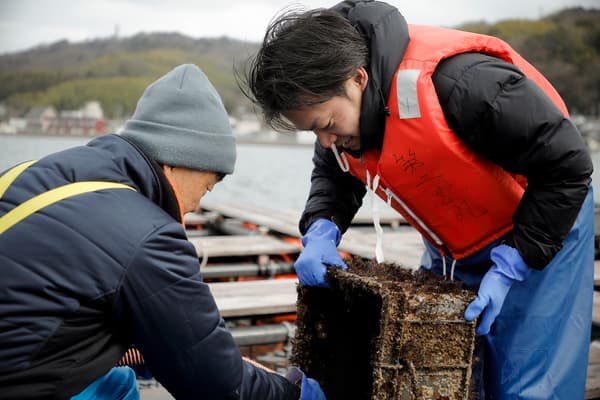
The team visited bivalve farmers Yasushi and Shutaro Hondo in Miyazu Bay. They learned about the mineral-rich environment created by nutrient-rich mountain water upwelling from the seafloor, and how the bay's high transparency supports the quality of the naturally occurring large surf clam. Participants also gained understanding of the aquaculture of native-seed giant surf clams and short-neck clams, and took part in portions of the aquaculture work, experiencing firsthand the demanding nature of operations at sea.
Training Session 2: Chef Discussion — The Restaurant as a Medium (April 27)
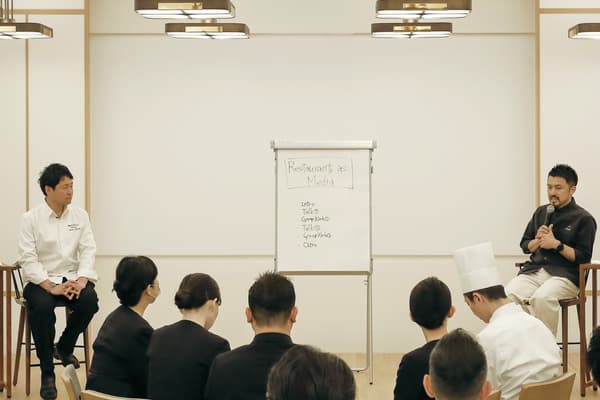
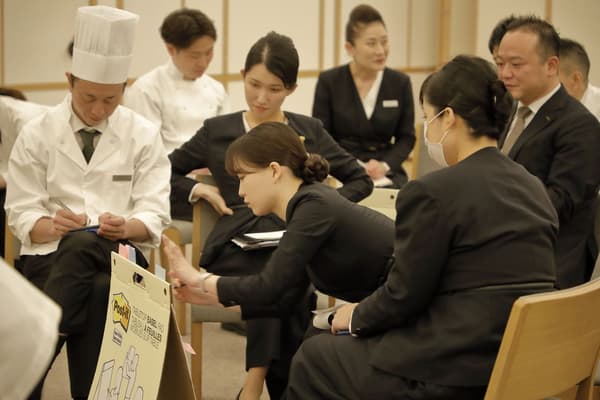
Chefs Sakamoto and Maeda gave presentations on the theme of "The Restaurant as a Medium." In the second half, service staff and chefs split into groups for active discussion on what sustainability means in a hotel context and what steps could be taken in daily operations. Many participants expressed a desire to steadily expand what they can do, even within the complexity of hotel operations — and the session became a meaningful stepping stone toward ongoing commitment.
Chef Profiles
Kentaro Koyama, Head Chef, Yasaka Signature Restaurant
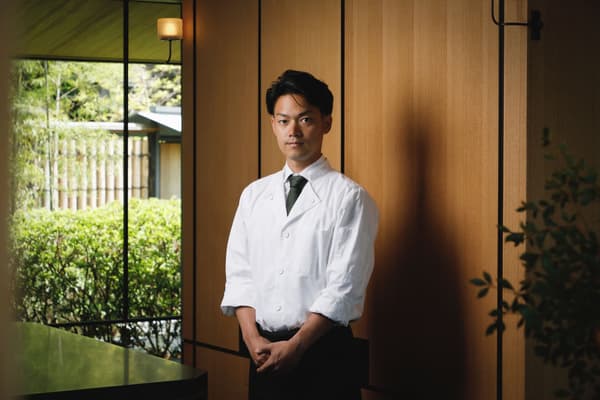
Born in Kumamoto in 1989, Koyama grew up appreciating food through his grandmother's garden vegetables and his mother's cooking. He began his career at a French restaurant in Tokyo in 2008, then moved to France in 2013, spending five years honing his craft at establishments including the three-starred Maison Lameloise in Burgundy. After returning to Japan, he became chef at French Monster, earning 3 toques in Gault & Millau 2022. Respecting classical technique while embracing creative flexibility, he crafts a one-of-a-kind dining experience at Yasaka where teppanyaki and French cuisine converge around Kyoto's rich ingredients.
Ken Sakamoto, Owner-Chef, cenci
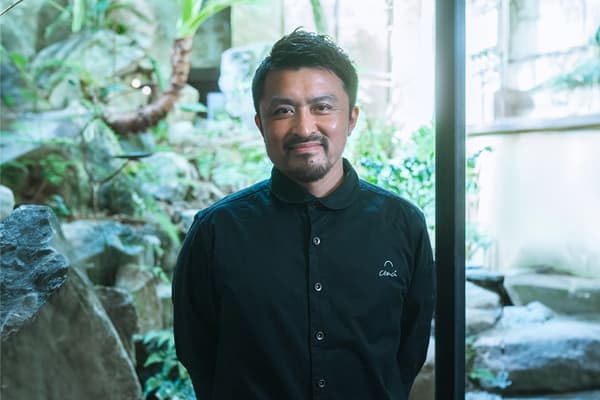
Born in Kyoto in 1975, Sakamoto encountered Italian cuisine during a trip to Europe while still at university and decided to become a chef. After training at Il Pappalardo, he served nine years as head chef at Il Ghiottone before independently opening cenci in Okazaki in 2014. Known for creating a new form of Italian cuisine using Japanese ingredients, Sakamoto is equally recognized for his commitment to sustainability — from ingredient sourcing and producer relationships to improving working conditions. He ranked in "Asia's 50 Best Restaurants" from 2022 to 2024 and has held a Michelin star since 2022. He is a Kyoto member of Chefs for the Blue.
Motoi Maeda, Owner-Chef, Restaurant MOTOÏ
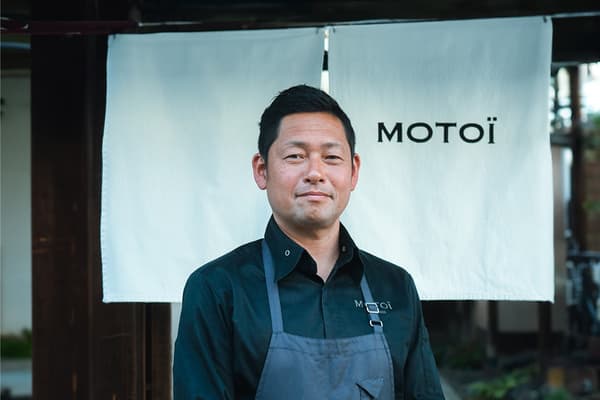
Born in Kyoto in 1976, Maeda began his career in the Chinese cuisine department of the former Kyoto Grand Hotel, then moved to Hotel Nikko Tokyo before heading to France, where he trained at La Madeleine in Burgundy and other establishments. After returning to Japan, he worked at Kyoto Hotel Okura and HAJIME in Osaka before opening MOTOÏ in Kyoto in 2012. Maeda pursues holistic restaurant sustainability, including building relationships with producers and improving team dynamics and working conditions. He is a Kyoto member of Chefs for the Blue.